Incorporation
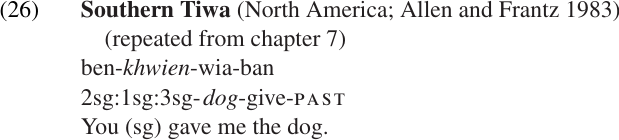
We presented a few examples like (26), in which the noun that expresses the object (‘dog’) is morphologically included as part of the verb. This pattern is called NOUN INCORPORATION (NI), and we say that the object noun has been “incorporated” into the verb. NI is a special type of compounding: a verb root and a noun root combine to form a complex stem whose category is V.
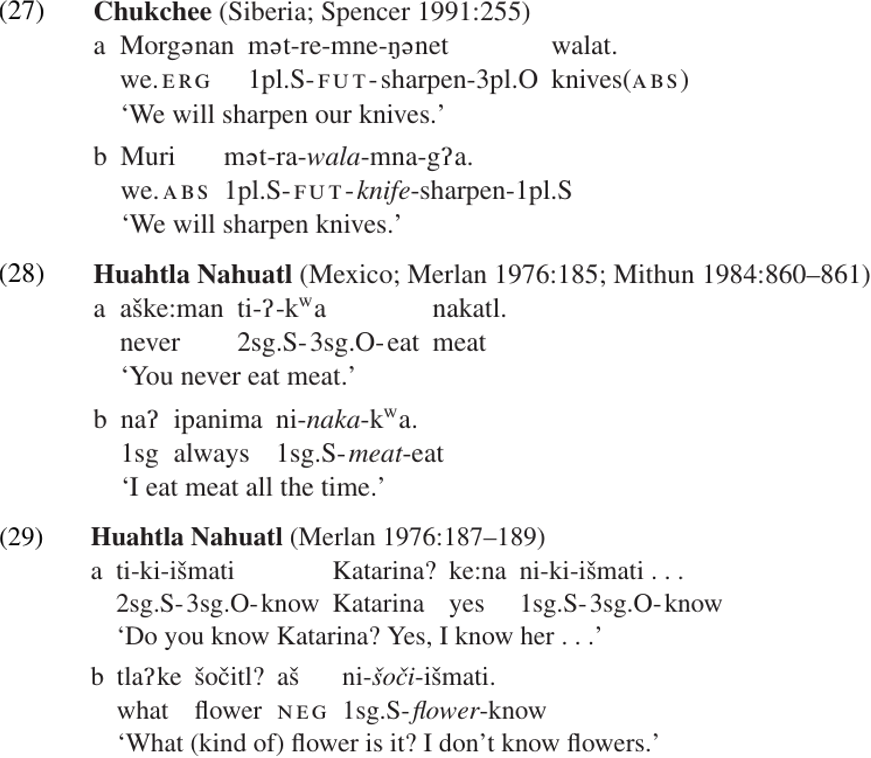
The most common kind if NI is that in which the incorporated noun functions as the object of the verb. Sometimes this results in a decrease in syntactic valence. For example, (27a) contains a transitive verb ‘sharpen’ which agrees with both SUBJ and OBJ. The subject NP gets ergative case and the object gets absolutive case. In (27b) the object ‘knife’ has been incorporated into the verb, so the verb is no longer marked for object-agreement. Moreover, the SUBJ of (27b) is now marked with absolutive case, indicating that it is the subject of an intransitive clause. We will refer to this pattern as valence-decreasing incorporation.11 Further examples of this pattern are given in (28b) and (29b).
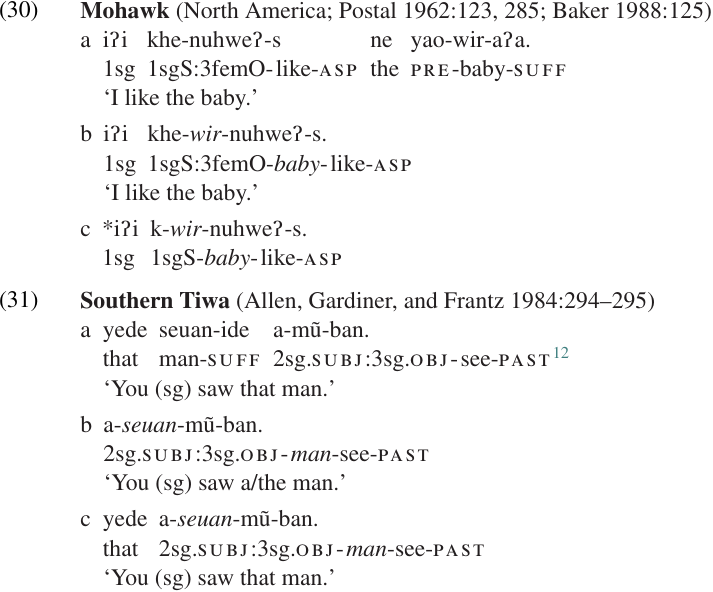
In other languages, however, NI does not reduce the valence of the verb. In (30b), for example, we see that the Mohawk verb continues to agree with its OBJ even when the OBJ is incorporated. If the verb is inflected as an intransitive, agreeing only with its SUBJ as in (30c), the sentence is ungrammatical. Similarly, a transitive verb in Southern Tiwa shows the same agreement pattern whether the object is an independent NP (31a) or an incorporated noun (31b). We will refer to this pattern as valence-preserving incorporation.
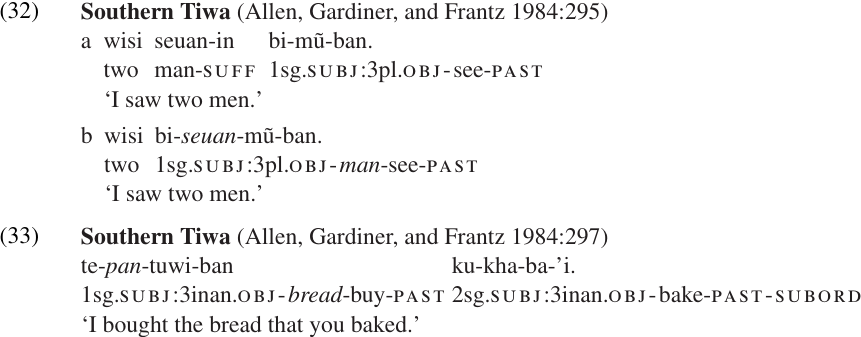
In many languages with valence-preserving incorporation, the in corporated noun can be modified by words or phrases that appear outside the verb: determiners (31c), numerals (32), and even relative clauses (33). These examples provide additional evidence that the verbs in these constructions are still transitive.13
A simple WFR which represents incorporation as a process of N+V compounding is suggested in (34). However, we will not attempt to write specific rules to express the differences between valence-decreasing and valence-preserving incorporation here.

11. Rosen (1989) and Gerdts (1998) refer to this type as “compounding incorporation,” and to our valence-preserving incorporation as “classifying incorporation.”
12. Allen, Gardiner, and Frantz’s glosses for OBJ-agreement actually refer to noun classes, which they label A, B, and C. These classes in turn are largely, but not entirely, determined by person, number, and animacy.
13. Under the analyses proposed by Mithun (1984) and Rosen (1989), the incorporated noun in the valence-preserving examples (30–33) is not the OBJ but only a kind of classifier, which restricts the semantic class of possible objects. Stranded modifiers like those in (31c, 32b, 33) involve a null N as head of the OBJ NP.








