Nominalization
A noun derived from a verb is called a DEVERBAL NOUN. In addition to abstract deverbal nouns like those in (14), which refer to the event itself, many languages have nominalizers which name specific participants or aspects of the event: agent, patient, instrument, location, manner, cause, etc. Some of these are illustrated in the following examples.
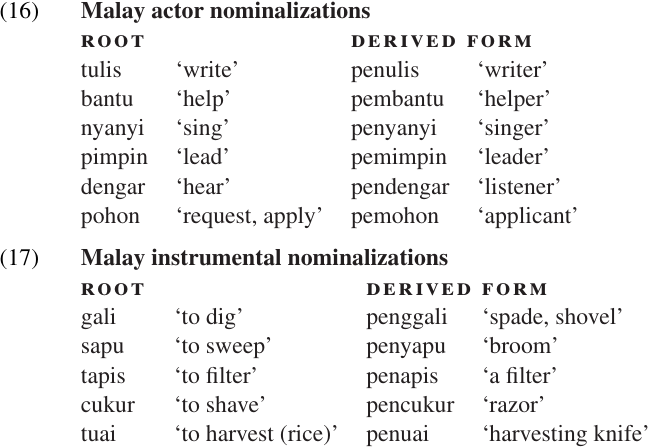
Note that the Malay examples in (16) and (17) use the same prefix, peN-, but with different meanings. (The N- here represents a nasal sound which changes according to its environment, and may also trigger changes in the following consonant. It is not at all uncommon for languages to use the same nominalizer for agentive and instrumental nouns; this pattern is found in Dutch, English, French, Italian, and a number of Malayo-Polynesian languages, to name a few.12
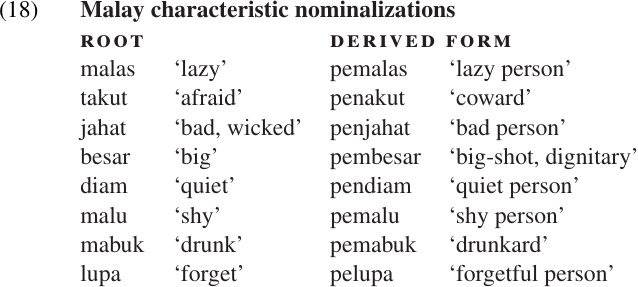
The prefix peN-has another use as well. It can be added to a verbal or adjectival root to derive a noun naming a person or thing that is characterized by the property named by the root, as illustrated in (18).
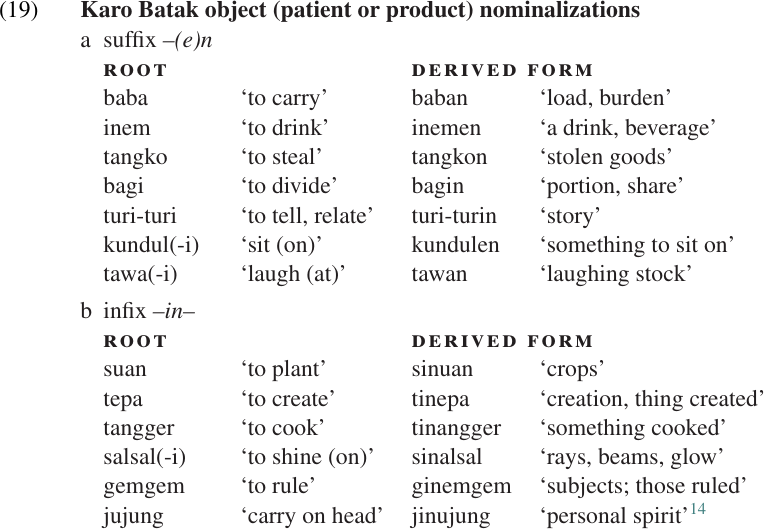
Karo Batak (Malayo-Polynesian, northern Sumatra) has two different ways of deriving “object nominals” from verbs; that is, nominalizations that express the patient or product of the action named by the verb. The most productive of these is formed by adding a suffix-(e)n, as illustrated in (19a). With certain roots, however, an infix–in–is used(19b).13
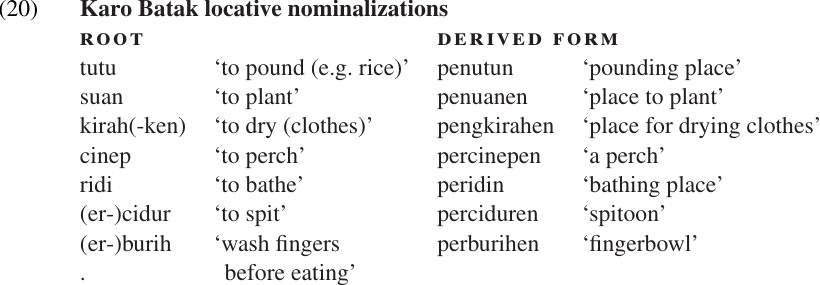
As a final example of deverbal nominalization, example (20) shows how nouns which name the place of an event are derived in Karo Batak. Notice that two different “circumfixes” are used: peN-X-(e)n (mostly with transitive roots) vs. per-X-(e)n (within transitive roots).
12. Booij (1986).
13. The Karo Batak data is taken from Wollams (1996:81–83, 89–90).
14. A personal spirit, worshipped by animists, is believed to be carried on one’s head.








