Classifier systems
Classifiers are independent words, often nouns, which occupy a special position in the noun phrase, but do not seem to contribute to the meaning of the NP in any definite way. English has no true classifiers; the closest parallels are probably a few frozen expressions like those in(4a).
The function of a classifier is in some respects similar to that of MEASURE WORDS like those in (4b), which allow us to quantify (or count) mass nouns.
This pattern is quite productive in English, and indeed most languages. But notice that, in terms of grammatical structure, the measure word itself is the head of the NP that contains it. This is not the case with classifiers.
(4) a a pair of scissors
five head of cattle
b two pounds of salt
three liters of juice
five bushels of wheat
10,000 barrels of oil
The Chinese noun phrases in (5) show some examples of true classifiers. Li and Thompson (1981) report that classifiers are obligatory when the noun is preceded by a numeral (5a,b), demonstrative (5c,d), or by certain quantifiers including ‘a few,’ ‘a certain,’ ‘every,’ etc. Notice that these classifiers, unlike measure words, are used primarily when the head of the NP is a count noun. Classifiers are not used in Chinese if the NP contains a measure word.
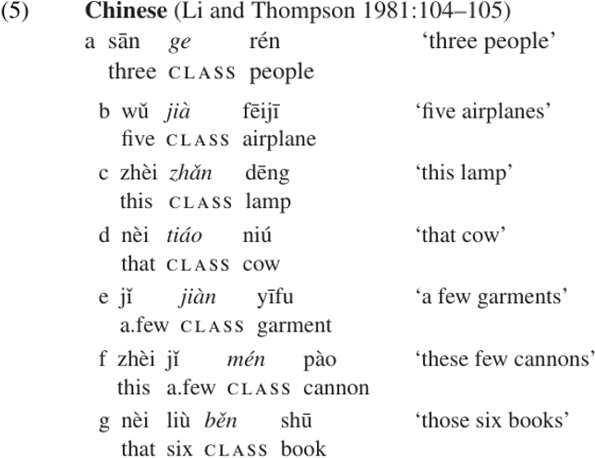
The choice of classifier depends on the specific noun that heads the NP. In many cases the nouns which take a particular classifier tend to have some semantic features in common, often relating to size and shape, but there are numerous exceptions. For example, the classifier tia̒o is used primarily for long, thin objects (e.g. ‘snake,’ ‘road,’ ‘river,’ ‘tail’) and four-legged mammals; but it is also used for various other nouns such as ‘news’ and ‘law.’ Moreover, some long thin objects (e.g. ‘brush-pen’ and ‘arrow’) take a different classifier. So, for most nouns, the choice of classifier cannot be predicted but must simply be memorized (and specified in the noun’s lexical entry).
The classifier system of Malay is somewhat similar to that of Chinese. Classifiers must be used with most countable nouns whenever a numeral is present, and also with certain definite quantifiers (e.g. ‘several’). The classifier word, italicized in the following examples, forms a constituent with the numeral or quantifier, and that constituent may occur either before or after the head noun:
(6) Malay (Asmah and Rama 1985)
a [dua orang] budak ‘two children’
two person child
or: budak [dua orang]
child two person
b [tiga batang] rokok ‘three cigarettes’
three stick smoke
or: rokok [tiga batang]
smoke three stick
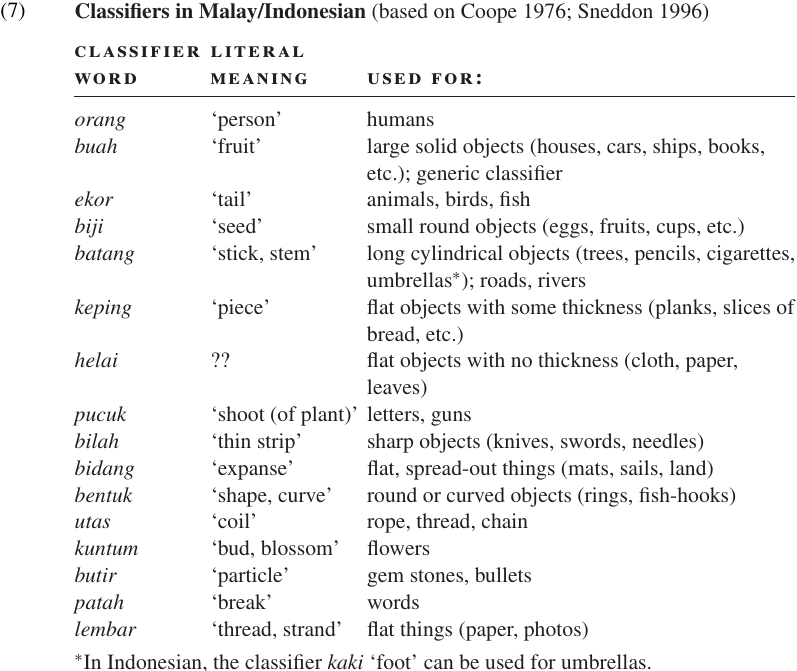
As in Chinese, the choice of classifier is partly determined on the basis of size and shape, but a number of other semantic features are involved as well. Many of the classifiers can also be used as independent nouns, though the meaning of these nouns is sometimes quite different from the semantic features associated with the classifier. The most commonly used classifier words are summarized in (7):