EXPRESSING ATTENDANT CIRCUMSTANCES
PLACE, TIME AND OTHER CIRCUMSTANCES
There are many parallel expressions of place and time, in many cases introduced by the same preposition:
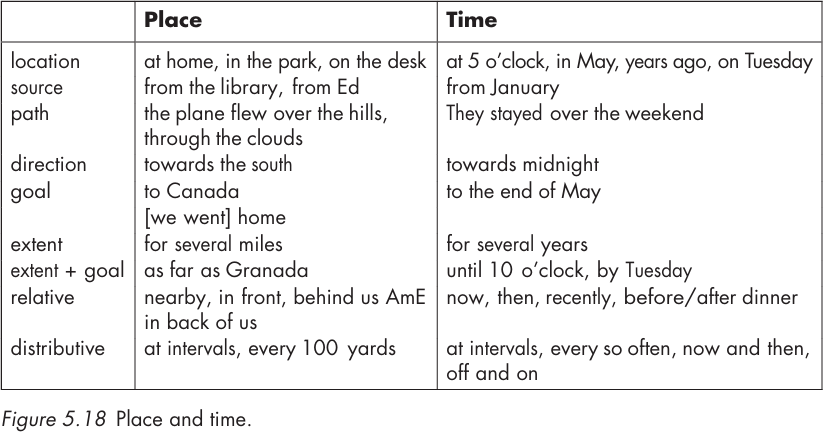
Locative, goal and directional meanings are questioned by where? (the preposition to is not used in questions other than the verbless Where to?); source meanings by where . . . from? and for time, since when? extent by how far? how long? and distribution by how often?
A. Manner: The notion of manner (How?) is extended to include the notions of means (By what means?, comparison (What like?) and instrumentality (What with?):
Manner how? Don’t do it that way; do it gently.
Means how? It’s cheaper by bus.
Comparison what . . . like? She was sobbing like a child.
Instrumentality What . . . with? He drew out the nail with a pair of pliers.
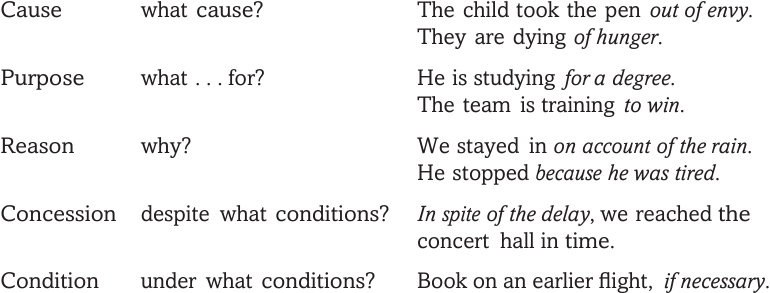
B. Cause, Purpose, Reason, Concession and Condition:
C. Accompaniment involves either the notion of ‘togetherness’ or that of ‘additionality’. Each of these can be either positive or negative:
togetherness positive Tom came with his friend/with a new haircut.
togetherness negative Tom came without his friend/without the car.
additionality positive Tom came as well as Paul.
additionality negative Tom came instead of Paul.
D. Degree: Circumstantial expressions of degree either emphasize or attenuate the process:
emphasis I completely forgot to bring my passport.
attenuation You can hardly expect me to believe that.
E. Role answers the question What as? or In what capacity?
I’m speaking to you as a friend.
As an actor he’s not outstanding, but as a dancer he’s brilliant.
F. Matter: This element adds the notion of ‘with reference to . . . ’ and is realized by a wide variety of simple and complex prepositions, including those bound or grammaticized prepositions that follow certain verbs and nouns such as deprive of, news of,:
We have been talking about the current economic crisis.
Is there any news of the missing seamen?
With regard to your order of July 17 . . .
As for that, I don’t believe a word of it.
G. Evidence relates to the source of information in verbal processes and is expressed by as x says, or according to x:
According to the weatherman, there will be heavy snowstorms this weekend.








