0
EN
1
المرجع الالكتروني للمعلوماتية

Grammar

Tenses

Present

Present Simple

Present Continuous

Present Perfect

Present Perfect Continuous

Past

Past Simple

Past Continuous

Past Perfect

Past Perfect Continuous

Future

Future Simple

Future Continuous

Future Perfect

Future Perfect Continuous

Parts Of Speech

Nouns

Countable and uncountable nouns

Verbal nouns

Singular and Plural nouns

Proper nouns

Nouns gender

Nouns definition

Concrete nouns

Abstract nouns

Common nouns

Collective nouns

Definition Of Nouns

Animate and Inanimate nouns

Nouns

Verbs

Stative and dynamic verbs

Finite and nonfinite verbs

To be verbs

Transitive and intransitive verbs

Auxiliary verbs

Modal verbs

Regular and irregular verbs

Action verbs

Verbs

Adverbs

Relative adverbs

Interrogative adverbs

Adverbs of time

Adverbs of place

Adverbs of reason

Adverbs of quantity

Adverbs of manner

Adverbs of frequency

Adverbs of affirmation

Adverbs

Adjectives

Quantitative adjective

Proper adjective

Possessive adjective

Numeral adjective

Interrogative adjective

Distributive adjective

Descriptive adjective

Demonstrative adjective

Pronouns

Subject pronoun

Relative pronoun

Reflexive pronoun

Reciprocal pronoun

Possessive pronoun

Personal pronoun

Interrogative pronoun

Indefinite pronoun

Emphatic pronoun

Distributive pronoun

Demonstrative pronoun

Pronouns

Pre Position

Preposition by function

Time preposition

Reason preposition

Possession preposition

Place preposition

Phrases preposition

Origin preposition

Measure preposition

Direction preposition

Contrast preposition

Agent preposition

Preposition by construction

Simple preposition

Phrase preposition

Double preposition

Compound preposition

prepositions

Conjunctions

Subordinating conjunction

Correlative conjunction

Coordinating conjunction

Conjunctive adverbs

conjunctions

Interjections

Express calling interjection

Phrases

Sentences

Clauses

Part of Speech

Grammar Rules

Passive and Active

Preference

Requests and offers

wishes

Be used to

Some and any

Could have done

Describing people

Giving advices

Possession

Comparative and superlative

Giving Reason

Making Suggestions

Apologizing

Forming questions

Since and for

Directions

Obligation

Adverbials

invitation

Articles

Imaginary condition

Zero conditional

First conditional

Second conditional

Third conditional

Reported speech

Demonstratives

Determiners

Direct and Indirect speech

Linguistics

Phonetics

Phonology

Linguistics fields

Syntax

Morphology

Semantics

pragmatics

History

Writing

Grammar

Phonetics and Phonology

Semiotics

Reading Comprehension

Elementary

Intermediate

Advanced

Teaching Methods

Teaching Strategies

Assessment

قم بتسجيل الدخول اولاً لكي يتسنى لك الاعجاب والتعليق.

PROCESSES OF SAYING, BEHAVING AND EXISTING VERBAL PROCESSES

المؤلف:  Angela Downing

المصدر:  ENGLISH GRAMMAR A UNIVERSITY COURSE

الجزء والصفحة:  P182-C5

2026-05-27

15

+

-

20

PROCESSES OF SAYING, BEHAVING AND EXISTING

VERBAL PROCESSES

Verbal processes are processes of ‘saying’ or ‘communicating’ and are encoded by such verbs as say, tell, repeat, ask, answer and report. They have one participant which is typically human, but not necessarily so (the Sayer) and a second essential participant, which is what is said or asked or reported (the Said). A Recipient is required with tell and may be present as a PC (e.g. to me) with other verbal processes:
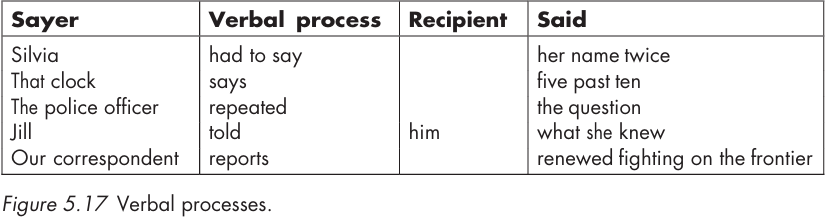
 

The Sayer can be anything which puts out a communicative signal (that clock, Jill, our correspondent). What is said is realized by a nominal group or a nominal what clause (what she knew). As these examples show, verbal processes are intermediate between material and mental processes. From one point of view, communicating is a form of ‘doing’, and in fact the Sayer is usually agentive or made to appear agentive, as in the case of the clock. Like material processes, verbal processes readily admit the imperative (Say it again!) and the progressive (What is he saying?).


On the other hand, the action of communicating is close to cognitive processes such as thinking. Verbs of saying, telling and others can be followed by a clause that represents either the exact words said (direct report) or a reported version of the meaning (indirect report). Many speech-act verbs can function in this way, to report statements, questions, warnings, advice and other speech acts:

She        said:                        ‘I won’t be late’ (quoted statement or promise)

She        said                         she wouldn’t be late (reported statement or promise)

She        said:                        ‘Don’t go to see that film’ (quoted directive: advice)

She        told          us            not to go to see that film (reported directive: advice)


When however, the message is encapsulated as a speech act by means of a nominal – such as ‘apology’, ‘warning’ and many others – it is treated as a participant in the verbal process. The verb then may express the manner of saying:

The airport authorities issued an apology

Someone shouted a warning

Retired cop vows revenge (press headline)


Wish in I wish you a merry Christmas is clearly both mental and verbal. Talk and chat are verbal processes, which have an implicit reciprocal meaning (They talked/chatted [to each other]). Talk has no second participant except in the expressions talk sense/ nonsense. Speak is not implicitly reciprocal and can take a Range participant. (She speaks Spanish. He speaks five languages).


اشترك بقناتنا على التلجرام ليصلك كل ما هو جديد

