THE IDENTIFYING PATTERN
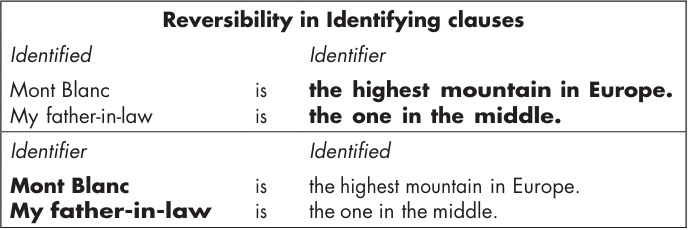
The participant roles in an identifying relationship are known as Identified and Identifier. Identification means that one participant, the Identified, is identified in terms of the other (the Identifier), in a relation of symbolic correlates. The Identifier is the one that fills the wh- element in a wh-question corresponding to the identifying clause:
(a) [What/Which is Mont Blanc?]
Mont Blanc (Identified) is the highest mountain in western Europe (Identifier).
(b) [Which is your father-in-law? Looking at a photograph]
My father-in-law (Identified) is the one in the middle (Identifier).
Identifying processes are reversible. The previous illustrations can be turned around, with the Identified/Identifying roles now represented by the opposite constituent:
(c) [What/Which is the highest mountain in western Europe?]
The highest mountain in Europe (Identified) is Mont Blanc (Identifier).
(d) [Who/Which is the one in the middle?]
The one in the middle (Identified) is my father-in-law (Identifier).
The difference between the two sequences lies in which element we want to identify; for instance, do we want to identify Mont Blanc or do we want to identify the highest mountain in Europe? In a discourse context this is a matter of presumed knowledge. Question (a) presumes that the listener has heard of Mont Blanc but doesn’t know its ranking among mountains. The answer could be ‘Mont Blanc (Identified) is the highest mountain in Europe (Identifier)’, in which the highlighted part represents tonic prominence and the new information. Question (c) presumes that our listener knows there are high mountains in Europe, but not which one is the highest, receiving the answer ‘The highest mountain in Europe (Identified) is Mont Blanc (Identifier)’. Alternatively, in answer to the same question Which is the highest mountain in Europe? we could say ‘Mont Blanc (Identifier) is the highest mountain in Europe (Identified)’.
In spoken discourse it is the Identifier that typically receives the tonic prominence that is associated with new information, whether this is placed at the end (the usual position) or at the beginning of the clause. In each sequence, then, one half is typically something or someone whose existence is already known (the Identified), whereas the Identifier presents information as unknown or new to the listener.
The following passage, Colors in Rugs across Cultures, illustrates such correspondences:
The meaning of individual colors varies from culture to culture. In Muslim countries, green – the color of Mohammed’s coat – is sacred and is very rarely used as a pre dominant color, but it forms an important part of the dyer’s palette in non-Muslim cultures, particularly in China; here, the sacred color is yellow, in which the Emperor traditionally dressed. White represents grief to the Chinese, Indians and Persians. Blue symbolizes heaven in Persia, and power and authority in Mongolia. Orange is synonymous with piety and devotion in Muslim countries, while red, the most universal rug color, is widely accepted as a sign of wealth and rejoicing.
[OX0]
Finally, the difference between the Attributive and the Identifying patterns is reflected in the syntax in three ways: Only the identifying type is reversible (cf. *A high mountain is Mont Blanc); only the characterizing type can be realized by an adjective (The unemployment figures are alarming); and nominal groups that realize characterizing Attributes are usually indefinite (a musician), while NGs that realize identifying Attributes are usually definite (the club Secretary).
Certain relational processes of possession can be analyzed by the Identifying pattern, and are reversible if suitably contextualized as identifying people’s possessions. For example, sandwiches: Yours is the ham-and-cheese; Tim’s is the egg-and-lettuce and mine is the tomato-and-tuna. Similarly, circumstantial Attributes can be reversed when explaining the layout of an area: Across the road, past the fountain is the Prado Museum. On your left is the Ritz Hotel. Further back is the Real Academia.








