THE ATTRIBUTIVE PATTERN
There is one participant, the Carrier, which represents an entity. Ascribed to the Carrier is an Attribute, which characterizes the entity in some way. Here are some examples:
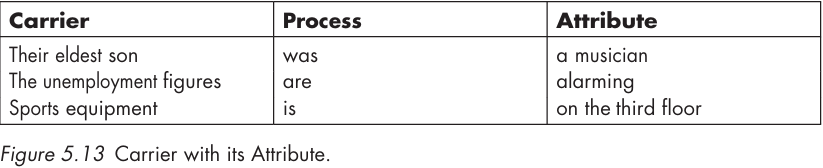
In the examples seen so far, the Attribute characterizes the entity in the following ways: as an instantiation of a class of entities (a mountain, a musician) or a sub-class (that of high mountains, as in (1); by a quality (popular with climbers, alarming); by a location (in the Alps, on the third floor); or as a type of possession (yours). There is an intensive relationship between the Carrier and its Attribute.
That is to say, the Carrier is in some way the Attribute. The Attribute is not a participant in the situation, and when realized by a nominal group the NG is non-referential; it can’t become the Subject in a clause. Attributive clauses are non-reversible in the sense that they don’t allow a Subject–Complement switch. They allow thematic fronting as in . . . and a fine musician he was too, but a fine musician is still the Attribute, and he the Subject.
The process itself, when encoded by be, carries little meaning apart from that of tense (past time as in was; present as in is, are). Its function is to link the Carrier to the Attribute. However, the process can be expressed either as a state or as a transition. With stative verbs such as be, keep, remain, seem and verbs of sensing, such as look (= ‘seem’), the Attribute is seen as existing at the same time as the process described by the verb and is sometimes called the current Attribute.
With dynamic verbs of transition such as become, get, turn, grow, run, the Attribute exists as the result of the process and can be called the resulting Attribute. Compare The weather is cold with The weather has turned cold.
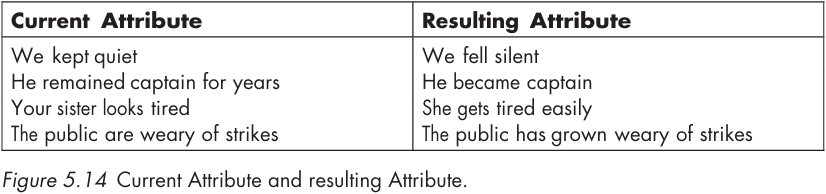
There is a wide variety of verbs in English to express both states and transitions. As states, the most common verbs of perception such as look, feel, sound, smell and taste keep their experiential meaning in relational clauses. An Experiencer participant (e.g. to me) can be optionally added to this semantic structure:
feel The surface feels too rough (to me)
feel as if My fingers feel as if they were dropping off with the cold
look Does this solution look right? (to you)
look like [What’s that insect?] It looks like a dragonfly (to me)
sound His name sounds familiar (to me)
smell That fish smells bad (to me)
taste This soup tastes of vinegar (to me)
The verb feel can function in two types of semantic structure: with an Experiencer/ Carrier (I feel hot; she felt ill), or with a neutral Carrier (the surface feels rather rough). In expressions referring to the weather, such as it is hot/cold/sunny/windy/frosty/cloudy/ foggy, there is no Carrier and much of the meaning is expressed by the Attribute.








