الوضع الليلي


 2:44:58
 2026-11-28
 14
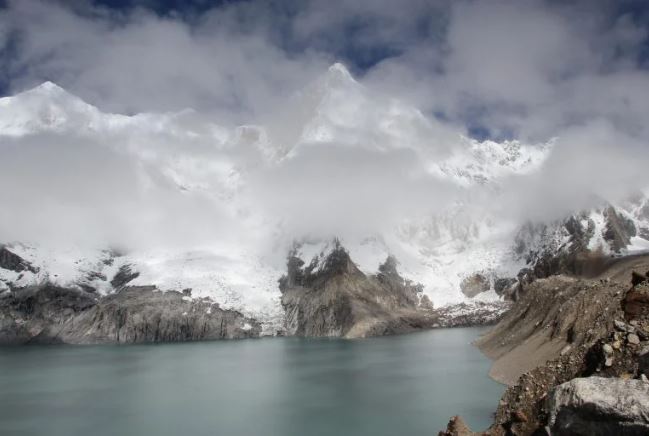
Where a glacier ends can influence how quickly it disappears, with implications for communities that depend on mountain meltwater or face the threat of flooding.
Between 2000 and 2020, the number of lakes in direct contact with glaciers worldwide grew by about 35 percent. Their expansion has consequences for the ice that remains. Lake water can melt glaciers from underneath, while chunks of ice can break away and fall into the water. Until recently, scientists had struggled to determine how much these processes contribute to glacier loss worldwide.
An international research team, including Tobias Bolch from the Institute of Geodesy at Graz University of Technology (TU Graz), used artificial intelligence to map glacial lakes from satellite images taken in 2000 and 2020. The researchers manually checked the results, distinguishing lakes that touched glaciers from those already separated from the ice. Their findings were published in Nature Climate Change.
Glaciers lose ice faster in lakes
Over the 20-year period, glaciers ending in lakes lost an average of 66 centimeters (26 inches) of water equivalent annually, meaning the lost ice would produce a layer of water that deep. By comparison, glaciers ending on land lost 40 centimeters (16 inches), and those ending in the sea lost 36 centimeters (14 inches).
“Our research has shown that contact with a lake further accelerates the loss of ice from a glacier,” says Tobias Bolch. “While the climate and the topography of the glacier are the most significant factors influencing glacial mass loss, lakes significantly exacerbate it.”
A surge in glacial lake water
The number of lakes touching glaciers increased by more than 3,500, with particularly pronounced expansion in Alaska and the southern Andes. Their combined area grew by around 600 square kilometers (232 square miles). They also gained an estimated 66 cubic kilometers of water, enough to submerge the entire city of Vienna under approximately 160 meters (525 feet) of water.
Climate alone cannot explain ice loss
Using machine learning models, the researchers found that glacier characteristics such as elevation and slope accounted for 46 percent of the explained influence on ice gains and losses. Temperature, precipitation, and other climatic factors accounted for around 43 percent, while glacial lakes contributed approximately 11 percent.
“The findings from this study will help us to estimate future changes to the glaciers more accurately,” says Tobias Bolch. “This is particularly important for mountainous regions and their forelands, where meltwater is a significant source of water. Such findings are also relevant when assessing the risks posed by glacial lakes in the event of potential outbursts.”
Reality Of Islam |
|
A faster wa
Metal foam

By filling
 9:3:43
2018-11-05
10 benefits of Marriage in Islam
7:5:22
2019-04-08
benefits of reciting surat yunus, hud &
9:45:7
2018-12-24
advantages & disadvantages of divorce
11:35:12
2018-06-10
6:0:51
2018-10-16
3:42:22
2021-12-24
7:34:7
2023-02-28
8:4:21
2022-01-08
8:3:0
2018-06-21
8:21:9
2018-06-21
al-hussain (peace be upon him)
10:18:1
2022-09-21
10:35:40
2022-05-26
5:41:46
2023-03-18
| LATEST |
 HOME