EXPRESSING OUR EXPERIENCE OF EVENTS
SYNTACTIC ELEMENTS OF STRUCTURE OF THE VERBAL GROUP
The Verbal Group is the grammatical unit by means of which we most typically express our perception of events. ‘Event’ will be used to cover all types of process in the transitivity structure, whether events, activities, states or acts of consciousness. These are described from the point of view of their place in the semantics of the clause.
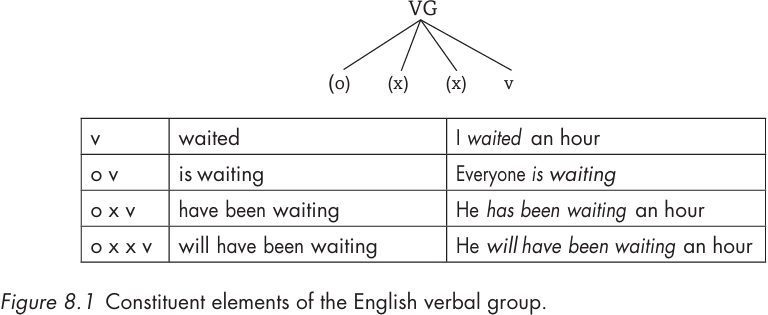
A simple verbal group consists of one lexical verb (e.g. take) or primary verb (a form of be, have, do) which indicates tense (past or present), as in takes, is, has, does, danced, flew. More complex verbal groups consist of a main verb (v) preceded by one or more grammatical elements – the auxiliary verbs (x), as in has been, has taken, is dancing.
The lexical and grammatical elements are all integral parts of an analytical form. The first auxiliary has a special status and is usually called the Finite operator, ‘operator’ for short (o).
The constituent elements of the English verbal group can therefore be represented and exemplified as in the diagram.