Quoted speech in conversation and written dialogue
Verbs used to introduce quoted speech in conversation and writing are summarized in the table below.
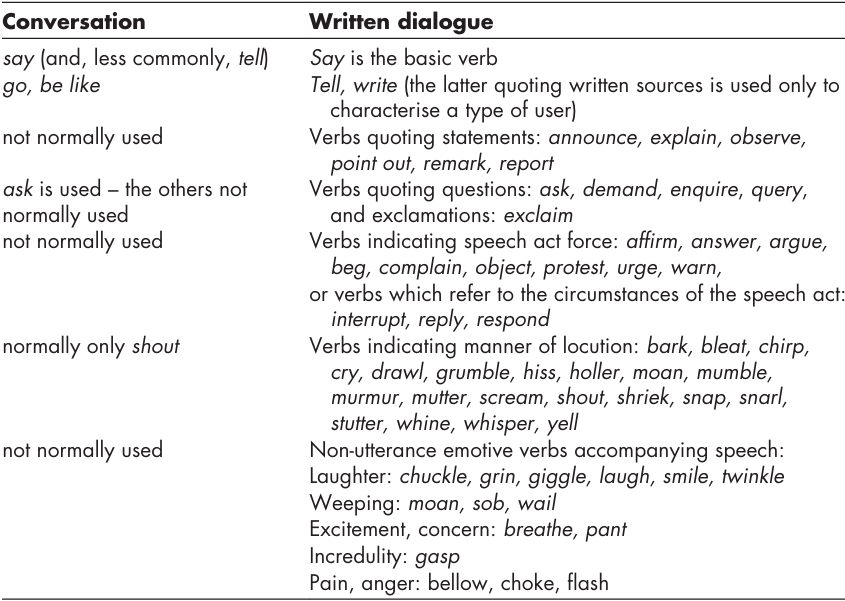
For the difference between say and tell. Basically, say is a two-place verb which does not take a core Recipient, not admitting, for example, *say me your name. Tell is a three-place verb with a core Recipient (tell me your name). Pragmatically, say is used to report what is said, while tell typically informs.
Go and be like are becoming widely used as quotative alternatives to say, both in younger speakers’ conversation and in the popular media. Like says and said, go and be like signal that the speaker is moving into direct speech mode. Normal combinations of tense and aspect occur with go and be like; however, the present tense appears to predominate even for past time reference (I’m like, she’s like):
. . . and I was going . . . I’ll have to take my stereo home and he goes yeah your stereo’s quite big isn’t it, and I went when have you seen my stereo and he goes oh
I came up the other day to see if you were in. I went why why, he said I just came round to your room and you weren’t there but your music was on. [KPH]
‘It’s just happened so fast,’ says the former Shanna Jackson. ‘Some days people will call me “Paris” and I’m like, “Who?” My mother still refuses to call me Paris.’ [HSJ]
The range of verbs used as ‘quotatives’ is wider in written dialogue than in spoken because writers attempt to heighten interest by conveying not only the words said but also something of voice quality, attitude and manner of speaking of the character, whether fictional or real. All these are perceived by hearers in a speech situation but are absent from basic verbs of saying.
‘I’ll take the cases,’ he whispered.
‘Trainers,’ I echoed, ‘What trainers?’
‘Come on, lads,’ Tommy yelled.
‘You’re mad at me, aren’t you?’ she wailed.
‘I said come in, Mrs Friar!’ John barked at her.
Direct reporting of thought
Not only words may be quoted, but also thoughts. The first two examples below are often heard in the spoken language, the third would be typical in fiction:
I think I’ll have a beer.
I wonder what he’s doing.
‘I’ll have to get a new bulb for this lamp,’ thought Peter.
Mental process verbs which occur as quotatives are few in number in English, in comparison with the wide variety of verbs used in quoted speech. They include think, the basic verb, and other verbs of cognition which express some additional, often aspectual meaning: muse, ponder, reflect, wonder.
In representing their characters’ thought, writers of fictional narrative often omit the prosodic signals of quoting (inverted commas or dashes), and make the clause of thinking parenthetical. The following extract from Virginia Woolf’s Mrs Dalloway illustrates this technique:
He’s very well dressed, thought Clarissa, yet he always criticizes me.
Here she is mending her dress; mending her dress as usual, he thought; here she’s been sitting all the time I’ve been in India; mending her dress; running to the House and back and all that, he thought, growing more and more irritated, more and more agitated, for there’s nothing in the world so bad for some women as marriage, he thought; and politics; and having a Conservative husband, like the admirable Richard. So it is, so it is, he thought, shutting his knife with a snap.








