COMMUNICATIVE ACTS
Let us start from the basic concept that language is for communication. Here is part of a recorded conversation taken from a sociological project of the University of Bristol. The speakers are Janice, a girl who runs a youth club and disco in an English town, and Chris, one of the boys in the club, who is 19 and works in a shop. In the dialogue, we can distinguish various types of communicative act, or speech act, by which people communicate with each other: making statements, asking questions, giving directives with the aim of getting the hearer to carry out some action, making an offer or promise, thanking or expressing an exclamation.
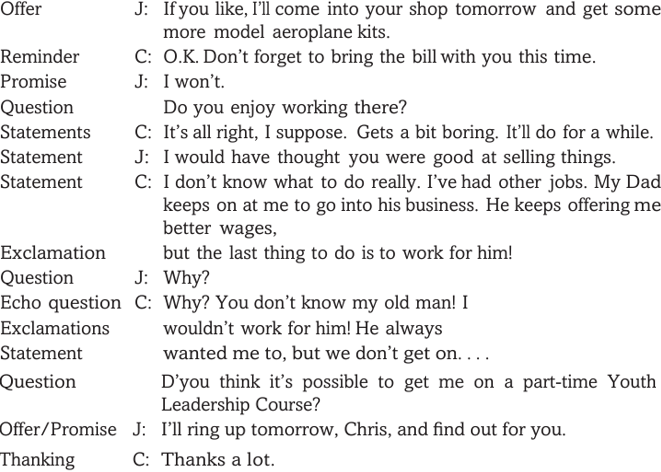
In a communicative exchange such as this, between two speakers, the kind of meaning encoded as questions, statements, offers, reminders and thanks is interpersonal meaning. Asking and stating are basic communicative acts. The thing asked for or stated may be something linguistic – such as information or an opinion (Do you enjoy working there? It’s all right, I suppose) – or it may be something non-linguistic, some type of goods and services, such as handing over the aeroplane kits.
This non-linguistic exchange may be verbalized – by, for instance, Here you are – but it need not be. Typically, however, when goods and services are exchanged, verbal interaction takes place too; for instance, asking a favor (Do you think it’s possible to get me on a part-time Youth Leadership Course?) or giving a promise (I’ll ring up tomorrow, Chris, and find out for you) are carried out verbally.








