Grammar
Tenses
Present

Present Simple
Present Continuous
Present Perfect
Present Perfect Continuous
Past
Past Simple
Past Continuous
Past Perfect
Past Perfect Continuous
Future
Future Simple
Future Continuous
Future Perfect
Future Perfect Continuous
Parts Of Speech
Nouns
Countable and uncountable nouns
Verbal nouns
Singular and Plural nouns
Proper nouns
Nouns gender
Nouns definition
Concrete nouns
Abstract nouns
Common nouns
Collective nouns
Definition Of Nouns
Animate and Inanimate nouns
Nouns
Verbs
Stative and dynamic verbs
Finite and nonfinite verbs
To be verbs
Transitive and intransitive verbs
Auxiliary verbs
Modal verbs
Regular and irregular verbs
Action verbs
Verbs
Adverbs
Relative adverbs
Interrogative adverbs
Adverbs of time
Adverbs of place
Adverbs of reason
Adverbs of quantity
Adverbs of manner
Adverbs of frequency
Adverbs of affirmation
Adverbs
Adjectives
Quantitative adjective
Proper adjective
Possessive adjective
Numeral adjective
Interrogative adjective
Distributive adjective
Descriptive adjective
Demonstrative adjective
Pronouns
Subject pronoun
Relative pronoun
Reflexive pronoun
Reciprocal pronoun
Possessive pronoun
Personal pronoun
Interrogative pronoun
Indefinite pronoun
Emphatic pronoun
Distributive pronoun
Demonstrative pronoun
Pronouns
Pre Position
Preposition by function
Time preposition
Reason preposition
Possession preposition
Place preposition
Phrases preposition
Origin preposition
Measure preposition
Direction preposition
Contrast preposition
Agent preposition
Preposition by construction
Simple preposition
Phrase preposition
Double preposition
Compound preposition
prepositions
Conjunctions
Subordinating conjunction
Correlative conjunction
Coordinating conjunction
Conjunctive adverbs
conjunctions
Interjections
Express calling interjection
Phrases
Sentences
Clauses
Part of Speech
Grammar Rules
Passive and Active
Preference
Requests and offers
wishes
Be used to
Some and any
Could have done
Describing people
Giving advices
Possession
Comparative and superlative
Giving Reason
Making Suggestions
Apologizing
Forming questions
Since and for
Directions
Obligation
Adverbials
invitation
Articles
Imaginary condition
Zero conditional
First conditional
Second conditional
Third conditional
Reported speech
Demonstratives
Determiners
Direct and Indirect speech
Linguistics
Phonetics
Phonology
Linguistics fields
Syntax
Morphology
Semantics
pragmatics
History
Writing
Grammar
Phonetics and Phonology
Semiotics
Reading Comprehension
Elementary
Intermediate
Advanced
Teaching Methods
Teaching Strategies
Assessment

Non-linear morphology
 المؤلف:
PAUL R. KROEGER
المؤلف:
PAUL R. KROEGER
 المصدر:
Analyzing Grammar An Introduction
المصدر:
Analyzing Grammar An Introduction
 الجزء والصفحة:
P304-C16
الجزء والصفحة:
P304-C16
 2026-02-07
 395
395


+
-
20
Non-linear morphology
Up to this point we have discussed only two kinds of morphological markers: prefixes and suffixes. For that reason, most of the word structures we have examined thus far have been quite “linear”: a simple sequence of morphemes (root plus affixes) strung together one after another, like beads on a string. However, we have already seen a few examples of more complex word structure.
We discussed the Tagalog aspect markers. We saw that realis non-active verbs are marked by an affix-in- that occurs, not before or after the root, but inside it, as illustrated in the “past” forms in (1). This marker is neither a prefix nor a suffix; we referred to it as an INFIX. We also saw that non-completive aspect is marked by copying the first consonant and vowel of the root, as seen in the “future” forms in (1). We referred to this process as REDUPLICATION.

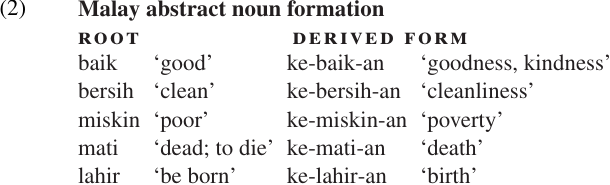
We referred to the Malay nominalizer ke- ...-an, illustrated in (2), as a CIRCUMFIX. Again, this affix is neither a prefix nor a suffix; it seems to be both at once, or rather a combination of the two.
Hockett (1954) discussed two different approaches that linguists have taken to the analysis of word structure. One of these, which he called the item and ARRANGEMENT (IA) model, assumes that all morphology is affixation. The rules of grammar must arrange the morphemes in the correct linear order, after which the rules of phonology will apply to produce the form that is actually pronounced.
The second approach, which Hockett called the ITEM AND PROCESS (IP) model, treats affixation as just one among many ways in which morphological rules may modify the form of the base. The IP model does not treat a morpheme as a string of phonemes which gets attached to the base, but rather as a pattern of phonological change which is associated with some consistent semantic or grammatical effect. Of course, one way in which the base form can be modified is simply to add a specific string of phonemes to it, resulting in affixation of the familiar sort. But many other kinds of modification are attested in human languages as well.
Circumfixes, in fixes, and reduplication are examples of morphological marking which is not simple, linear, affixation. These patterns, and others to be discussed below, are difficult to represent in a position class chart, and (at least at first glance) seem to cause serious problems for the IA model. However, recent developments in phonological theory have made it possible to describe many of these processes as special types of affixation. So, the debate between the IA and IP viewpoints continues to be a major topic of discussion in morphological theory.
The theoretical issues involved are far beyond our scope. Our primary goal will be to introduce the standard terminology used for various types of non-linear morphology, and to help you recognize these patterns when you encounter them.
 الاكثر قراءة في Morphology
 اخر الاخبار
اخبار العتبة العباسية المقدسة

الآخبار الصحية


مواضيع ذات صلة
 قسم الشؤون الفكرية يصدر كتاباً يوثق تاريخ السدانة في العتبة العباسية المقدسة
 "المهمة".. إصدار قصصي يوثّق القصص الفائزة في مسابقة فتوى الدفاع المقدسة للقصة القصيرة
 (نوافذ).. إصدار أدبي يوثق القصص الفائزة في مسابقة الإمام العسكري (عليه السلام)