Case
How are subjects, direct objects, and secondary objects identified in the following Malayalam sentences?
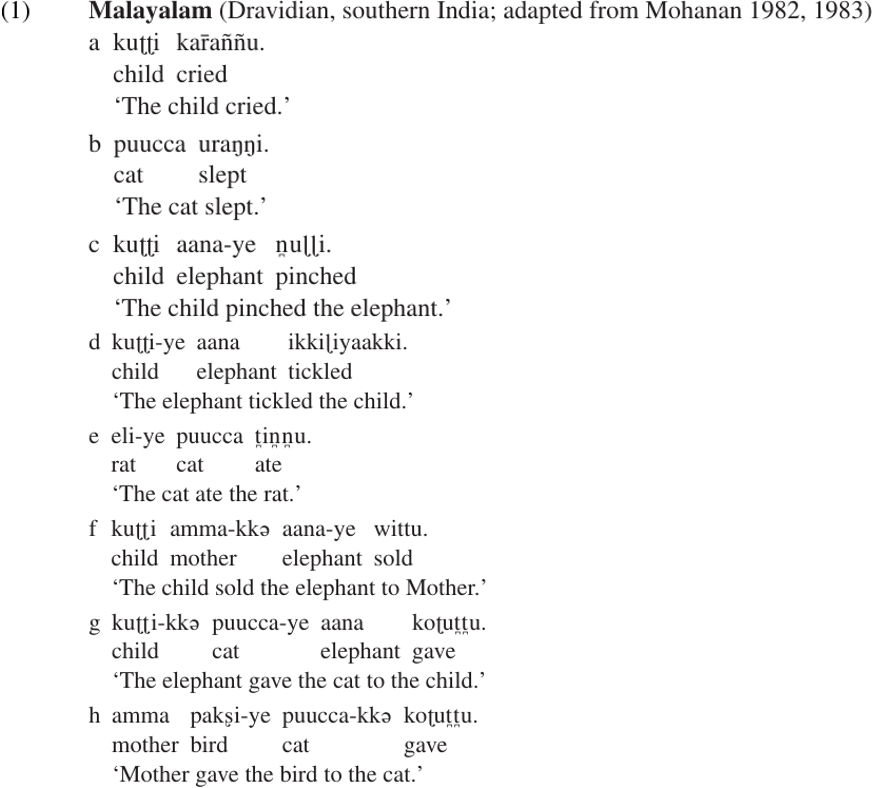
As these examples illustrate, Malayalam relies on noun morphology for identifying Grammatical Relations: direct objects take the suffix–ye,1 recipient secondary objects take the suffix-kkə, and subjects are “unmarked” (no suffix is added).
Affixes of this kind, which are added to a noun or NP to indicate the Grammatical Relation of that NP, are referred to as CASE markers. More generally, any system in which the Grammatical Relation of an NP is indicated by some kind of morphological marking on the NP itself is referred to as a CASE SYSTEM. For example, the first and third person pronouns in English appear in variant forms which reflect case distinctions (I, me, my; he, him, his; we, us, our; etc.).2 This is virtually all that remains of the case system which affected nouns as well as pronouns in Old English.
1. This suffix is pronounced /-e/ following consonants, /-ye/ following vowels.
2. The 2nd person pronoun has only two distinct forms, your possessive vs. you nom/acc.








