Positive and negative sentences
The following are all positive sentences:
1. I will think about it.
2. Timothy has called her.
3. The teacher was listening.
Can you turn them into negative sentences, using the word not? The related negative sentences are:
4. I will not think about it.
5. Timothy has not called her.
6. The teacher was not listening.
(Of course, native speakers of ten put not in contractions, saying, for example, I won’t think about it instead of I will not think about it; we will not be focusing on the contractions in our discussion here.)
No native speaker of English would make the negative sentence something like, *I will think about not it. That’s because there’s a systematic relationship between positive and negative sentences, even though they don’t have the same meaning. We’re not usually consciously thinking about how to make a sentence negative, but we know how to do it, and we do it in a consistent way.
Can you figure out exactly where you put not in a sentence when you make it negative?
Here are some negative sentences, with not underlined and the helping verb in bold.
7. I am not going there next week.
8. That phone might not work.
9. She has not written to me often.
Where does the not go? You can see that it goes right after the helping verb.
What if a sentence has more than one helping verb? Again, the not in each sentence below is underlined; the helping verbs are in bold.
10. That phone should not have worked.
11. She has not been writing to me often.
12. Those people should not have been attending the conference.
What pattern do you notice? You can see that not is always placed after the first helping verb.
Quick tip
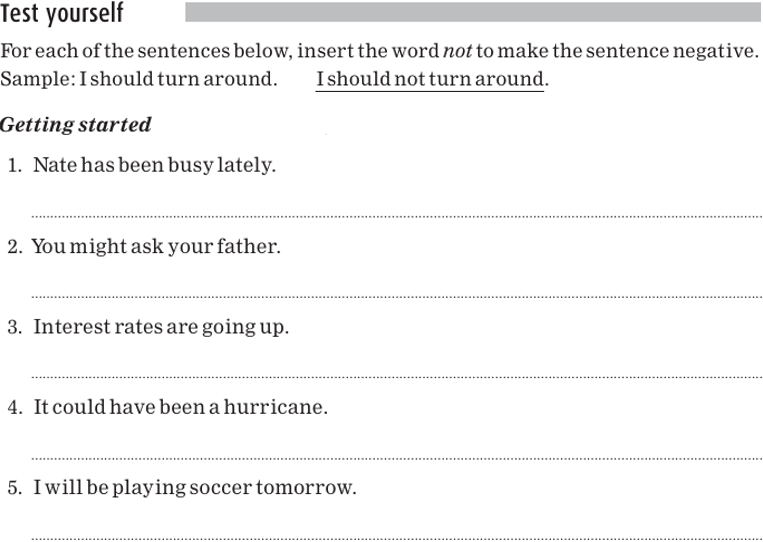
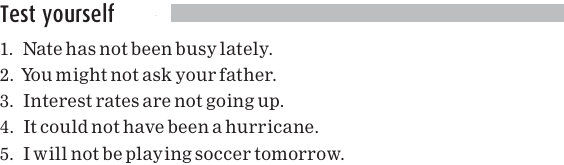
A sentence is made negative by inserting not after the first helping verb.
Answers
Now make the following sentence negative:
13. I went there last week.
You probably ended up with the following:
14. I did not go there last week.
How did did end up here? Let’s look at some more examples to figure it out:
15a. She writes to me often.
15b. She does not write to me of ten.
16a.Many important people attended the conference.
16b.Many important people did not attend the conference.
If we look at one of these sentences, such as I went there last week, we can see that it has a main verb, went, but no helping verb. So when a sentence has no helping verb but we need one, for example, to make the sentence negative, we use a form of do as the helping verb. Notice that in that case, the tense information is not on the main verb, but on the form of do instead (do, does, did). This is exactly as expected. You may recall that tense is always indicated by the first verb; since do, and not the main verb, is the first verb in the sentence, it is the one that carries the tense information. This leaves the main verb in its base form. (The same is true for person and number information, distinguishing between do and does.)
Answers
Quick tip
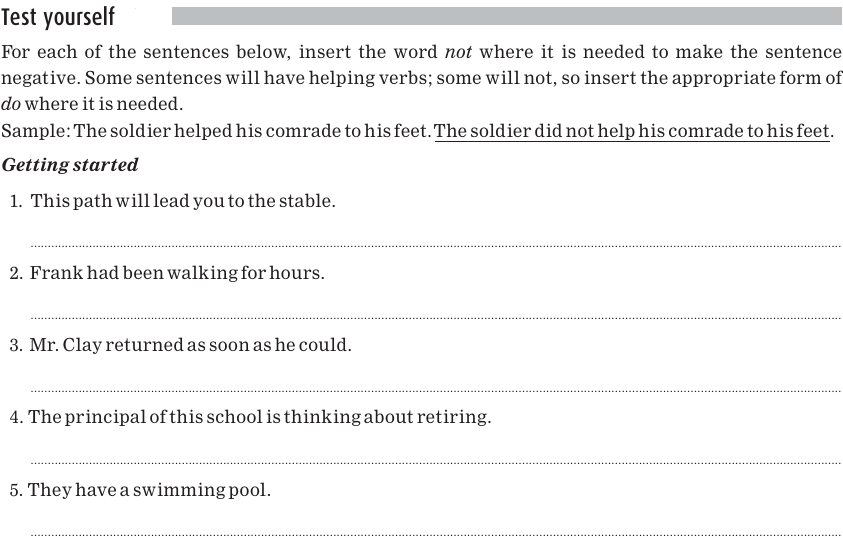
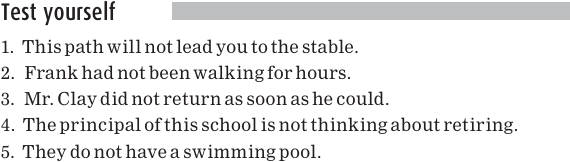
In negative sentences, we use a form of do as the helping verb if the sentence does not have any other helping verb. Example: He does not like spaghetti.
There is one main verb that doesn’t use do to form a negative sentence, even when the sentence has no helping verb: that exception is be. In these next examples, there is no helping verb, just the main verb be (underlined); you can see that no form of do is needed to form a negative sentence.
17a. She is awake now. (positive sentence)
17b. She is not awake now. (negative sentence)
18a. The judges were in their chambers. (positive sentence)
18b. The judges were not in their chambers. (negative sentence)
To enhance your understanding
The verb do has a number of different uses. Here are some examples:
19. I did not study. (helping verb)
20. I did it. (main verb)
21. I did think of it! (emphasis)








