Case studies
Mandarin
Mandarin has two basic strategies for forming Yes–No questions. One involves the use of a sentence-final particle ma (23c), while the other involves a kind of alternative question which is sometimes referred to as the “A-not-A” pattern (23d). As (24) shows, the alternative can involve either are petition of the verb alone (24b), of the verb plus object as a unit (26c), or of the copular verb shì ‘is’(24d).
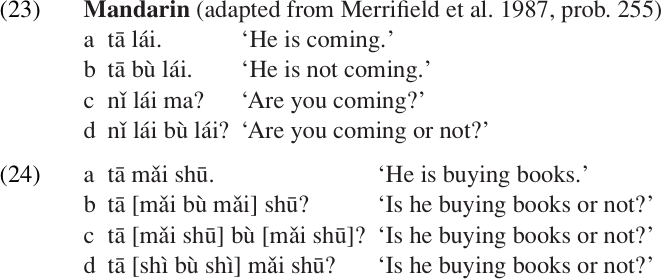
These two strategies, final particle vs. A-not-A alternative question, seem to have the same function, and pairs of sentences like (23c) and (23d) are often interchangeable. However, Li and Thompson (1981) state that there is a difference in the way the two patterns can be used. The A-not-A question can be used only in “neutral” contexts, i.e. where the questioner has no prior assumptions or expectations about the answer to the question. Particle questions, on the other hand, can be used either in neutral contexts or in contexts where the questioner wishes to signal some prior expectation about what the answer should be. Consider the sentences in (25), from Li and Thompson (1981:551):
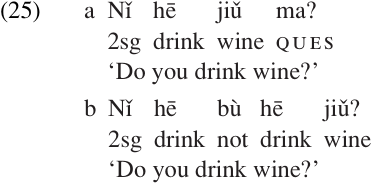
If the speaker is dining in a restaurant with a new acquaintance, and wants to find out whether it is appropriate to order wine with the meal, then either (25a) or (25b) would be acceptable. This is a neutral context, because the speaker has no prior knowledge or expectation about the answer. But if the speaker is dining with an old friend whom he knows to be a strict tee-totaling Baptist, and is surprised to see this friend order wine with the meal, only (25a) would be appropriate. The A-not-A pattern (25b) would be very unnatural, because the speaker has definite prior expectations about the answer.
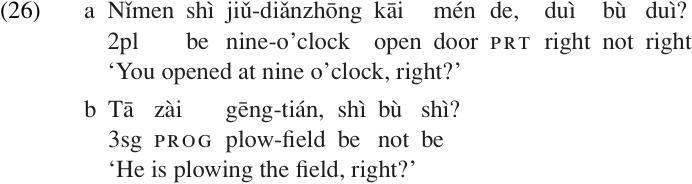
Tag questions are formed by adding a simple A-not-A question at the end of a statement. The examples in (26) are from Li and Thompson (1981:546).
Avery frequently used Yes–No question consists of just the copula followed by the question particle: shì ma? ‘Really? Is that so? Is that right?’
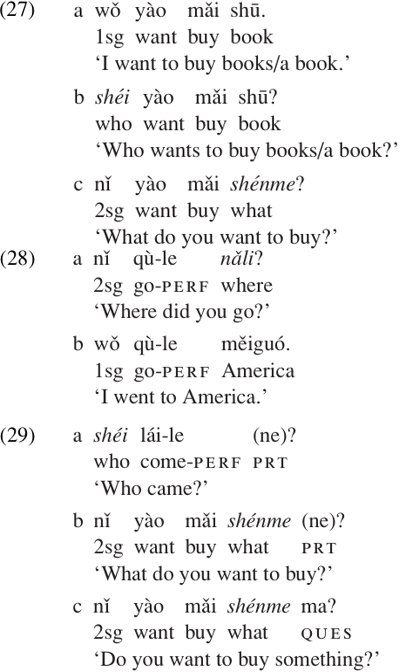
In Mandarin content questions, the question word remains in situ, as illustrated in (27–28). There is another sentence-final particle ne which optionally occurs in content questions (29a, b), but the Yes–No particle ma does not occur in content questions. If ma is added to a content question, the question word is re-interpreted as a quantifier (29c) and the whole sentence becomes a Yes–No question.