Butadiene and π-electron binding energy
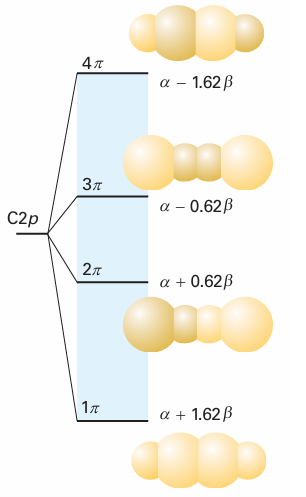
As we saw in the preceding example, the energies of the four LCAO-MOs for butadiene are , E=α±1.62β, α±0.62β , These orbitals and their energies are drawn in Fig. 11.39. Note that the greater the number of internuclear nodes, the higher the energy of the orbital. There are four electrons to accommodate, so the ground-state configuration is 1π2 2π2. The frontier orbitals of butadiene are the 2π orbital (the HOMO, which is largely bonding) and the 3πorbital (the LUMO, which is largely antibonding). ‘Largely’ bonding means that an orbital has both bonding and antibonding interactions between various neighbours, but the bonding effects dominate. ‘Largely antibonding’ indicates that the antibonding effects dominate.
An important point emerges when we calculate the total π-electron binding energy, Eπ, the sum of the energies of each π electron, and compare it with what we find in ethene. In ethene the total energy is
Eπ =2(α+β)=2α+2β
In butadiene it is
Eπ =2(α+1.62β) +2(α+0.62β) =4α+4.48β
Therefore, the energy of the butadiene molecule lies lower by 0.48β (about 110 kJ mol−1) than the sum of two individual π bonds. This extra stabilization of a con jugated system is called the delocalization energy. A closely related quantity is the π-bond formation energy, the energy released when a π bond is formed. Because the contribution of α is the same in the molecule as in the atoms, we can find the π-bond formation energy from the π-electron binding energy by writing
Ebf = Eπ −Nα
where N is the number of carbon atoms in the molecule. The π-bond formation energy in butadiene, for instance, is 4.48β
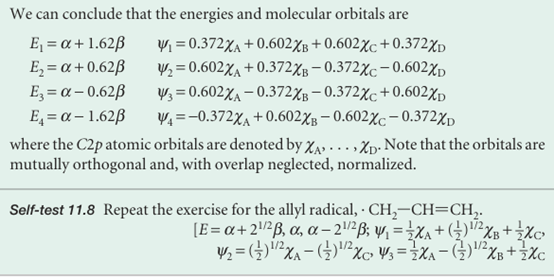
Fig. 11.39 The Hückel molecular orbital energy levels of butadiene and the top view of the corresponding π orbitals. The four p electrons (one supplied by each C) occupy the two lower π orbitals. Note that the orbitals are delocalized.