Indirect objects
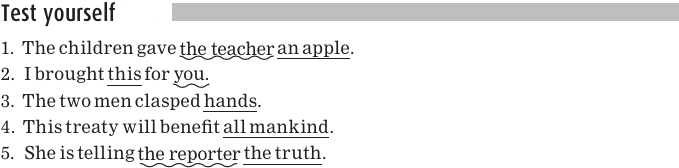
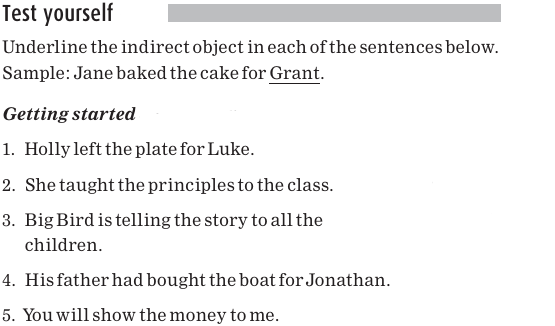
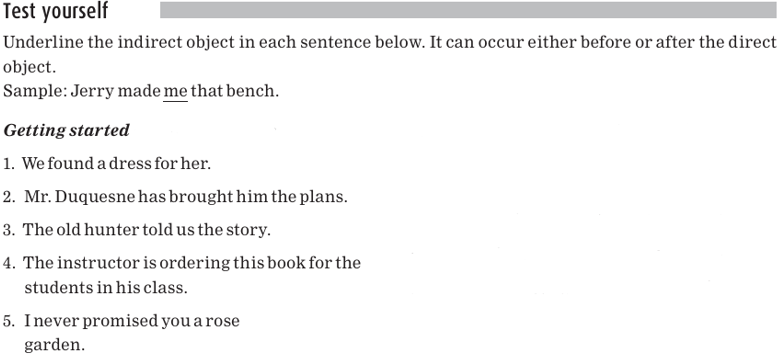
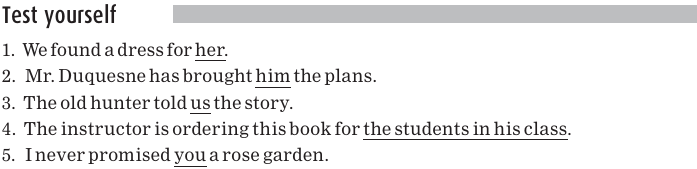
Sometimes a noun phrase is the answer to the question: ‘‘Who or what is receiving the direct object?’’ This noun phrase is called the indirect object. The indirect objects are underlined in the sentences below.
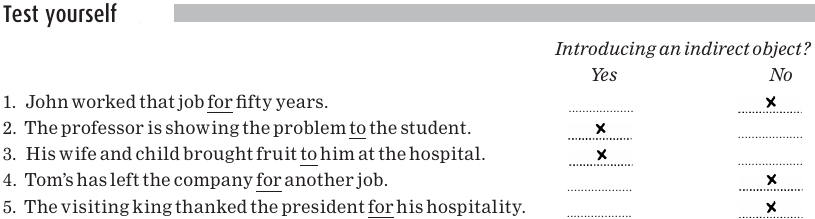
1. Mary gave the information to Robert.
2. She told the truth to her granddaughter.
3. They bought a car for their teenage daughter.
4. The accountant is giving a present to her husband.
So in sentence 4, for instance, the noun phrase a present is the direct object and the noun phrase her husband is the indirect object, since her husband is receiving the present, the direct object.
Quick tip
The indirect object of a sentence can be found by answering the question: ‘‘Who or what is receiving the direct object?’’
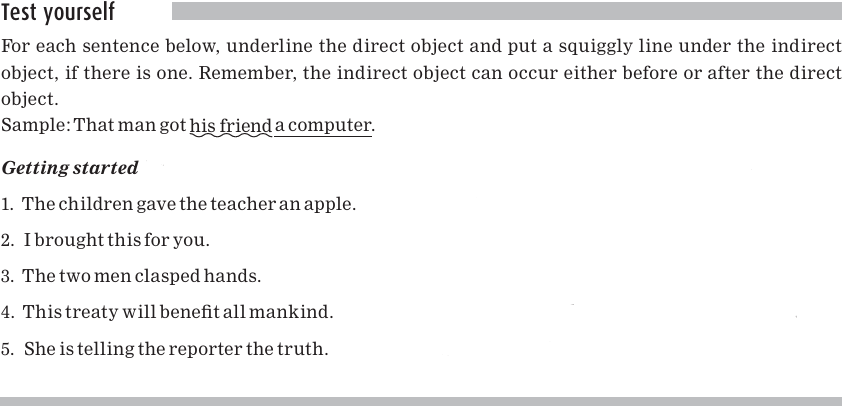
You can see that sentences that have indirect objects must also have direct objects, since indirect objects receive direct objects. The opposite is not true: sentences with direct objects don’t necessarily have indirect objects.
A direct object and an indirect object each follows the verb and is referred to by the term object. The term object can also refer to objects of a preposition, that is, noun phrases that follow prepositions.
Quick tip
The indirect object of a sentence can be found by answering the question: ‘‘Who or what is receiving the direct object?’’
You can see that sentences that have indirect objects must also have direct objects, since indirect objects receive direct objects. The opposite is not true: sentences with direct objects don’t necessarily have indirect objects.
A direct object and an indirect object each follows the verb and is referred to by the term object. The term object can also refer to objects of a preposition, that is, noun phrases that follow prepositions.
Answers
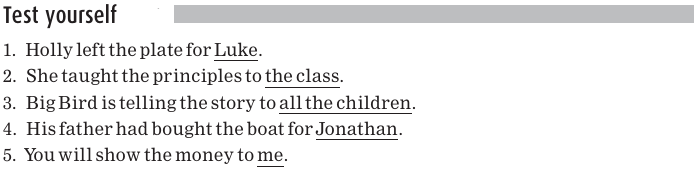
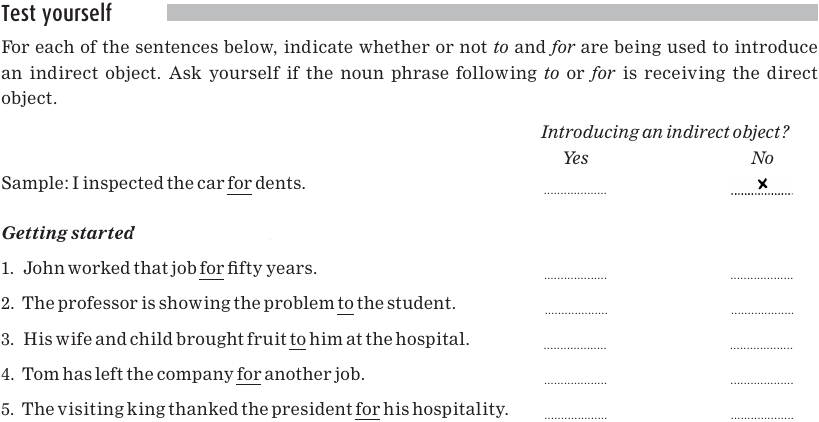
Indirect objects are introduced by the preposition to or for. Some verbs, such as tell and show, use to to introduce an indirect object, while some verbs, such as buy and leave, use for.
To and for do not function only to introduce indirect objects; often, to and for have other functions. Take a look at these next sentences and notice the differences between them:
5.Mary gave the baby to Robert.
6.Mary carried the baby to the corner.
In both sentences, Mary is the subject, the doer of the action, and the baby is the direct object, the receiver of the action. In sentence 5, Robert is receiving the baby, the direct object, so Robert is the indirect object. However, in sentence 6 the corner is not receiving the baby and so it’s not the indirect object. (It’s the object of the preposition to)
Here’s a similar pair of sentences:
7.He got a gift for his wife.
8.He got a gift for his birthday.
In both sentences, He is the subject, the doer of the action, and a gift is the direct object, the receiver of the action. In sentence 7, his wife is receiving a gift, the direct object, so his wife is the indirect object. However, in sentence 8 his birthday is not receiving a gift, so it’s not the indirect object. (It’s the object of the preposition for.)
Answers
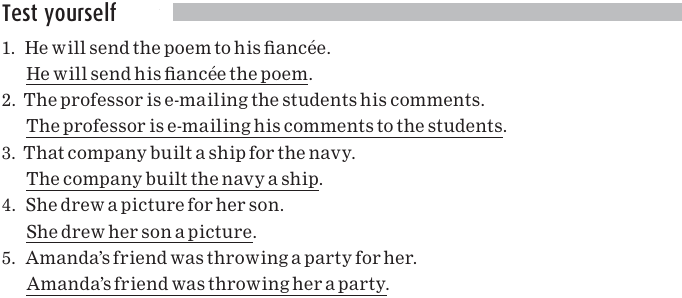
Here are sentences 1-4 again, but this time with a ‘‘partner’’ sentence:
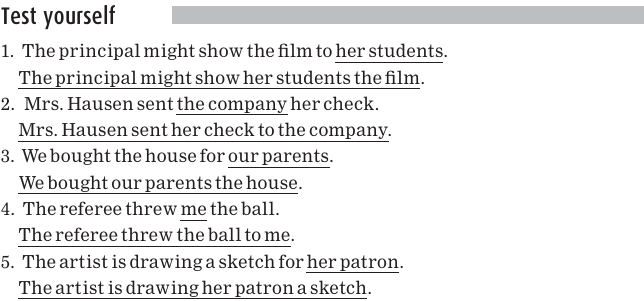
9a. Mary gave the information to Robert.
9b. Mary gave Robert the information.
10a. She told the truth to her granddaughter.
10b. She told her granddaughter the truth.
11a. They bought a car for their teenage daughter.
11b. They bought their teenage daughter a car.
12a. The accountant is giving a present to him.
12b. The accountant is giving him a present.
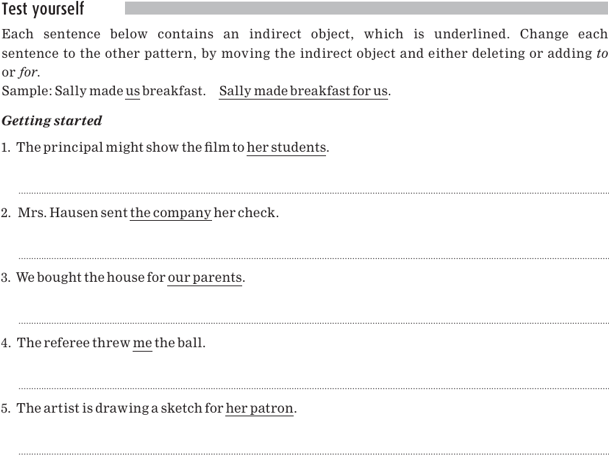
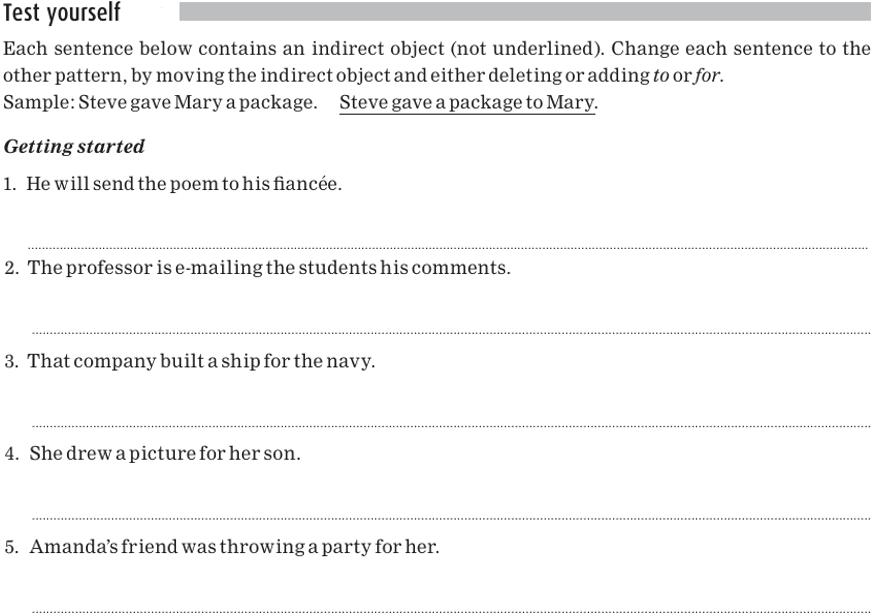
You can see that in the second sentence of each pair, the indirect object has moved so that it comes before the direct object, rather than after it. English gives us two choices for the position of indirect objects: (a) the indirect object can occur after the direct object (which follows the verb), with to or for introducing it, or (b) the indirect object can occur before the direct object (and after the verb), without to or for.
Quick tip
An indirect object can occur: (a) after the direct object (which follows the verb), with to or for introducing it, or (b) before the direct object (and after the verb), without to or for. For example: Joan gave a present to Bill or Joan gave Bill a present. (Bill is the indirect object in both sentences.)
Quick tip
To help you decide if a sentence has an indirect object, see if the sentence can be changed from a pattern like The boys left a note for their teacher to a sentence with a pattern like The boys left their teacher a note, or vice versa.
Note that when the direct object is a pronoun, the two patterns are not both possible, as you can see in these next sentence pairs:
13a. Her best friend bought it for her family.
13b. *Her best friend bought her family it.
14a. Lucy sold them to her neighbor.
14b. *Lucy sold her neighbor them.
That is, when the direct object is a pronoun, it must come before the indirect object.
Quick tip
If the direct object is a pronoun, it must come before the indirect object. Example: My sister sent it to her friend, *My sister sent her friend it.
Answers
Answers
Answers
Answers