Velar
Velar fricatives are regularly found in at least two varieties of British English: Scottish English and Liverpool English. In Scottish English, the velar fricative occurs in a few peculiarly Scottish lexical items such as ‘driech’, [drix], a term to describe dark, grey, cloudy weather, and ‘loch’, [lɔx], a kind of lake or inlet from the sea.
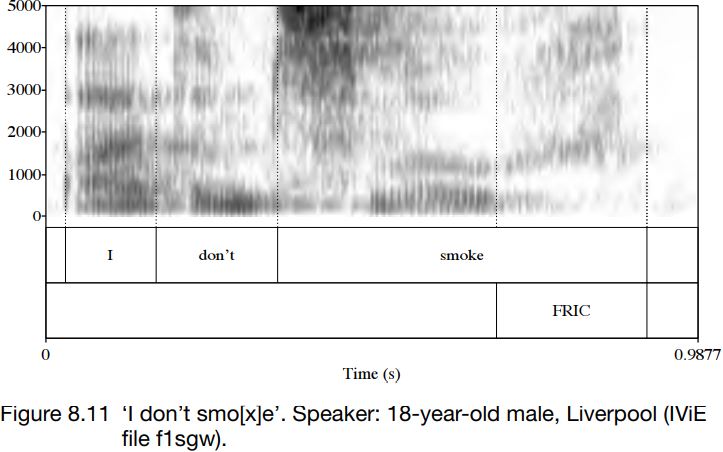
Liverpool also has fricatives where other varieties have [k] after vowels. The friction is made with the tongue body or back, from palatal through to uvular articulations, depending on the preceding vowel: a more forward place of articulation with front vowels, a backer place of articulation with back vowels, as in ‘week’,  , ‘back’, [bax], ‘dock’, [dɒχ]. Figure 8.11 shows a spectrogram of a Liverpool speaker saying ‘I don’t smoke’
  . Notice the last portion, labelled FRIC, which has no voicing, but has prolonged friction all the way through.