

Grammar


Tenses


Present

Present Simple

Present Continuous

Present Perfect

Present Perfect Continuous


Past

Past Simple

Past Continuous

Past Perfect

Past Perfect Continuous


Future

Future Simple

Future Continuous

Future Perfect

Future Perfect Continuous


Parts Of Speech


Nouns

Countable and uncountable nouns

Verbal nouns

Singular and Plural nouns

Proper nouns

Nouns gender

Nouns definition

Concrete nouns

Abstract nouns

Common nouns

Collective nouns

Definition Of Nouns

Animate and Inanimate nouns

Nouns


Verbs

Stative and dynamic verbs

Finite and nonfinite verbs

To be verbs

Transitive and intransitive verbs

Auxiliary verbs

Modal verbs

Regular and irregular verbs

Action verbs

Verbs


Adverbs

Relative adverbs

Interrogative adverbs

Adverbs of time

Adverbs of place

Adverbs of reason

Adverbs of quantity

Adverbs of manner

Adverbs of frequency

Adverbs of affirmation

Adverbs


Adjectives

Quantitative adjective

Proper adjective

Possessive adjective

Numeral adjective

Interrogative adjective

Distributive adjective

Descriptive adjective

Demonstrative adjective


Pronouns

Subject pronoun

Relative pronoun

Reflexive pronoun

Reciprocal pronoun

Possessive pronoun

Personal pronoun

Interrogative pronoun

Indefinite pronoun

Emphatic pronoun

Distributive pronoun

Demonstrative pronoun

Pronouns


Pre Position


Preposition by function

Time preposition

Reason preposition

Possession preposition

Place preposition

Phrases preposition

Origin preposition

Measure preposition

Direction preposition

Contrast preposition

Agent preposition


Preposition by construction

Simple preposition

Phrase preposition

Double preposition

Compound preposition

prepositions


Conjunctions

Subordinating conjunction

Correlative conjunction

Coordinating conjunction

Conjunctive adverbs

conjunctions


Interjections

Express calling interjection

Phrases

Sentences


Grammar Rules

Passive and Active

Preference

Requests and offers

wishes

Be used to

Some and any

Could have done

Describing people

Giving advices

Possession

Comparative and superlative

Giving Reason

Making Suggestions

Apologizing

Forming questions

Since and for

Directions

Obligation

Adverbials

invitation

Articles

Imaginary condition

Zero conditional

First conditional

Second conditional

Third conditional

Reported speech

Demonstratives

Determiners


Linguistics

Phonetics

Phonology

Linguistics fields

Syntax

Morphology

Semantics

pragmatics

History

Writing

Grammar

Phonetics and Phonology

Semiotics


Reading Comprehension

Elementary

Intermediate

Advanced


Teaching Methods

Teaching Strategies

Assessment
Sound changes
المؤلف:
George Yule
المصدر:
The study of language
الجزء والصفحة:
231-17
5-3-2022
2174
Sound changes
In a number of changes from Middle to Modern English, some sounds disappeared from the pronunciation of certain words, in a process simply described as sound loss. The initial [h] of many Old English words was lost, as in hlud → loud and hlaford → lord. Some words lost sounds, but kept the spelling, resulting in the “silent letters” of contemporary written English. Word-initial velar stops [k] and [ɡ] are no longer pronounced before nasals [n], but we still write the words knee and gnaw with the remnants of earlier pronunciations.
Another example is a velar fricative [x] that was used in the older pronunciation of nicht as [nɪxt] (closer to the Modern German pronunciation of Nacht), but is absent in the contemporary form night, as [naɪt]. A remnant of this sound is still present in some dialects, as at the end of the Scottish word loch, but it is no longer a consonant in Modern English speech.
The sound change known as metathesis involves a reversal in position of two sounds in a word. This type of reversal is illustrated in the changed versions of these words from their earlier forms.

The cowboy who pronounces the expression pretty good as something close to purty good is producing a similar example of metathesis as a dialect variant within Modern English. In some American English dialects, the form aks, as in I aksed him already, can still be heard instead of ask.
The reversal of position in metathesis can sometimes occur between non-adjoining sounds. The Spanish word palabra is derived from the Latin parabola through the reversal of the [l] and [r] sounds. The pattern is exemplified in the following set.
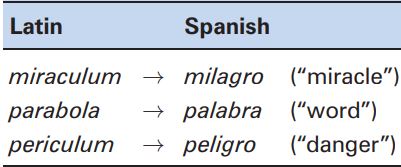
Another type of sound change, known as epenthesis, involves the addition of a sound to the middle of a word.

The addition of a [p] sound after the nasal [m], as in empty, can also be heard in some speakers’ pronunciation of something as “sumpthing.” Anyone who pronounces the word film as if it were “filum,” or arithmetic as “arithametic,” is producing examples of epenthesis in Modern English.
One other type of sound change worth noting, though not found in English, occurs in the development of other languages. It involves the addition of a sound to the beginning of a word and is called prothesis. It is a common feature in the evolution of some forms from Latin to Spanish, as in these examples.

Spanish speakers who are starting to learn English as a second language will sometimes put a prothetic vowel at the beginning of some English words, with the result that words like strange and story may sound like “estrange” and “estory.”
الاكثر قراءة في History
اخر الاخبار
اخبار العتبة العباسية المقدسة
الآخبار الصحية

قسم الشؤون الفكرية يصدر كتاباً يوثق تاريخ السدانة في العتبة العباسية المقدسة
"المهمة".. إصدار قصصي يوثّق القصص الفائزة في مسابقة فتوى الدفاع المقدسة للقصة القصيرة
(نوافذ).. إصدار أدبي يوثق القصص الفائزة في مسابقة الإمام العسكري (عليه السلام)


