تاريخ الرياضيات

الاعداد و نظريتها
تاريخ التحليل
تار يخ الجبر
الهندسة و التبلوجي
الرياضيات في الحضارات المختلفة
العربية
اليونانية
البابلية
الصينية
المايا
المصرية
الهندية
الرياضيات المتقطعة
المنطق
اسس الرياضيات
فلسفة الرياضيات
مواضيع عامة في المنطق
الجبر
الجبر الخطي
الجبر المجرد
الجبر البولياني
مواضيع عامة في الجبر
الضبابية
نظرية المجموعات
نظرية الزمر
نظرية الحلقات والحقول
نظرية الاعداد
نظرية الفئات
حساب المتجهات
المتتاليات-المتسلسلات
المصفوفات و نظريتها
المثلثات
الهندسة
الهندسة المستوية
الهندسة غير المستوية
مواضيع عامة في الهندسة
التفاضل و التكامل
المعادلات التفاضلية و التكاملية
معادلات تفاضلية
معادلات تكاملية
مواضيع عامة في المعادلات
التحليل
التحليل العددي
التحليل العقدي
التحليل الدالي
مواضيع عامة في التحليل
التحليل الحقيقي
التبلوجيا
نظرية الالعاب
الاحتمالات و الاحصاء
نظرية التحكم
بحوث العمليات
نظرية الكم
الشفرات
الرياضيات التطبيقية
نظريات ومبرهنات
علماء الرياضيات
500AD
500-1499
1000to1499
1500to1599
1600to1649
1650to1699
1700to1749
1750to1779
1780to1799
1800to1819
1820to1829
1830to1839
1840to1849
1850to1859
1860to1864
1865to1869
1870to1874
1875to1879
1880to1884
1885to1889
1890to1894
1895to1899
1900to1904
1905to1909
1910to1914
1915to1919
1920to1924
1925to1929
1930to1939
1940to the present
علماء الرياضيات
الرياضيات في العلوم الاخرى
بحوث و اطاريح جامعية
هل تعلم
طرائق التدريس
الرياضيات العامة
نظرية البيان

Zero
 المؤلف:
Beeler, M. and Gosper, R. W. Item 57 in Beeler, M.; Gosper, R. W.; and Schroeppel, R.
المؤلف:
Beeler, M. and Gosper, R. W. Item 57 in Beeler, M.; Gosper, R. W.; and Schroeppel, R.
 المصدر:
HAKMEM. Cambridge, MA: MIT Artificial Intelligence Laboratory, Memo AIM-239
المصدر:
HAKMEM. Cambridge, MA: MIT Artificial Intelligence Laboratory, Memo AIM-239
 الجزء والصفحة:
...
الجزء والصفحة:
...
 13-8-2020
 3435
3435


+
-
20
Zero
Zero is the integer denoted 0 that, when used as a counting number, means that no objects are present. It is the only integer (and, in fact, the only real number) that is neither negative nor positive. A number which is not zero is said to be nonzero. A root of a function  is also sometimes known as "a zero of
  ."
."
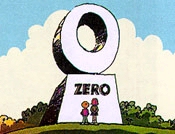
The Schoolhouse Rock segment "My Hero, Zero" extols the virtues of zero with such praises as, "My hero, zero Such a funny little hero But till you came along We counted on our fingers and toes Now you're here to stay And nobody really knows How wonderful you are Why we could never reach a star Without you, zero, my hero How wonderful you are."
Zero is commonly taken to have the factorization  (e.g., in the Wolfram Language's FactorInteger[n] command). On the other hand, the divisors and divisor function
  are generally taken to be undefined, since by convention,
  (i.e.,
  divides 0) for every
  except zero.
Because the number of permutations of 0 elements is 1,  (zero factorial) is defined as 1 (Wells 1986, p. 31). This definition is useful in expressing many mathematical identities in simple form.
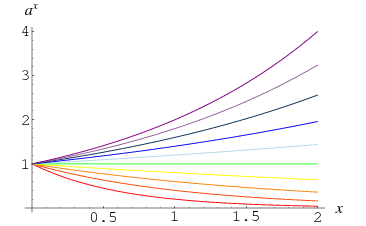
A number other than 0 taken to the power 0 is defined to be 1, which follows from the limit
 |
(1) |
This fact is illustrated by the convergence of curves at  in the plot above, which shows
  for
for  , 0.4, ..., 2.0. It can also be seen more intuitively by noting that repeatedly taking the square root of a number
  gives smaller and smaller numbers that approach one from above, while doing the same with a number between 0 and 1 gives larger and larger numbers that approach one from below. For
  square roots, the total power taken is
  , which approaches 0 as
  is large, giving
  in the limit that
  is large.
 itself is undefined. The lack of a well-defined meaning for this quantity follows from the mutually contradictory facts that
  is always 1, so
  should equal 1, but
  is always 0 (for
  ), so
), so  should equal 0. It could be argued that
  is a natural definition since
 |
(2) |
However, the limit does not exist for general complex values of  . Therefore, the choice of definition for
  is usually defined to be indeterminate.
However, defining  allows some formulas to be expressed simply (Knuth 1992; Knuth 1997, p. 57), an example of which is the beautiful analytical formula for the integral of the generalized sinc function
![int_0^infty(sin^ax)/(x^b)dx=(pi^(1-c)(-1)^(|_(a-b)/2_|))/(2^(a-c)(b-1)!)sum_(k=0)^(|_a/2_|-c)(-1)^k(a; k)(a-2k)^(b-1)[ln(a-2k)]^c](https://mathworld.wolfram.com/images/equations/Zero/NumberedEquation3.gif) |
(3) |
given by Kogan (cf. Espinosa and Moll 2000), where  ,
,  , and
, and  is the floor function.
Richardson's theorem is a fundamental result in decidability theory which establishes that the determination of whether even simple expressions are identically equal to zero is undecidable in principle, let alone in practice.
The following table gives the first few numbers  such that the decimal expansion of
  contains no zeros for small
  (a problem that resembles Gelfand's question.) The largest known
  for which
  contain no zeros is 86 (Madachy 1979), with no other
  (M. Cook, pers. comm., Sep. 26, 1997 and Mar. 16, 1998), improving the
  limit obtained by Beeler and Gosper (1972). The values
  such that the positions of the rightmost zero in
  increases are 10, 20, 30, 40, 46, 68, 93, 95, 129, 176, 229, 700, 1757, 1958, 7931, 57356, 269518, ... (OEIS A031140). The positions in which the rightmost zeros occur are 2, 5, 8, 11, 12, 13, 14, 23, 36, 38, 54, 57, 59, 93, 115, 119, 120, 121, 136, 138, 164, ... (OEIS A031141). The rightmost zero of
  occurs at the 217th decimal place, the farthest over for powers up to
  .
.
 |
Sloane |  such that such that  contains no 0s contains no 0s |
| 2 | A007377 | 1, 2, 3, 4, 5, 6, 7, 8, 9, 13, 14, 15, 16, 18, 19, 24, 25, 27, 28, ... |
| 3 | A030700 | 1, 2, 3, 4, 5, 6, 7, 8, 9, 11, 12, 13, 14, 19, 23, 24, 26, 27, 28, ... |
| 4 | A030701 | 1, 2, 3, 4, 7, 8, 9, 12, 14, 16, 17, 18, 36, 38, 43, ... |
| 5 | A008839 | 1, 2, 3, 4, 5, 6, 7, 9, 10, 11, 17, 18, 30, 33, 58, ... |
| 6 | A030702 | 1, 2, 3, 4, 5, 6, 7, 8, 12, 17, 24, 29, 44, ... |
| 7 | A030703 | 1, 2, 3, 6, 7, 10, 11, 19, 35 |
| 8 | A030704 | 1, 2, 3, 5, 6, 8, 9, 11, 12, 13, 17, 24, 27 |
| 9 | A030705 | 1, 2, 3, 4, 6, 7, 12, 13, 14, 17, 34 |
| 11 | A030706 | 1, 2, 3, 4, 6, 7, 8, 9, 12, 13, 14, 15, 16, 18, 41, ... |
While it has not been proven that the numbers listed above are the only ones without zeros for a given base, the probability that any additional ones exist is vanishingly small. Under this assumption, the sequence of largest  such that
  contains no zeros for
  , 3, ... is then given by 86, 68, 43, 58, 44, 35, 27, 34, 0, 41, ... (OEIS A020665).
REFERENCES:
Beeler, M. and Gosper, R. W. Item 57 in Beeler, M.; Gosper, R. W.; and Schroeppel, R. HAKMEM. Cambridge, MA: MIT Artificial Intelligence Laboratory, Memo AIM-239, p. 22, Feb. 1972. https://www.inwap.com/pdp10/hbaker/hakmem/number.html#item57.
Espinosa, O. and Moll, V. H. "On Some Definite Integrals Involving the Hurwitz Zeta Function." https://arxiv.org/abs/math/0012078. 11 Dec 2000.
Finch, S. R. Mathematical Constants. Cambridge, England: Cambridge University Press, 2003.
Knuth, D. E. "Two Notes on Notation." Amer. Math. Monthly 99, 403-422, 1992.
Knuth, D. E. The Art of Computer Programming, Vol. 1: Fundamental Algorithms, 3rd ed. Reading, MA: Addison-Wesley, p. 57, 1997.
Kogan, S. "A Note on Definite Integrals Involving Trigonometric Functions." Unpublished manuscript, n.d.
Madachy, J. S. Madachy's Mathematical Recreations. New York: Dover, pp. 127-128, 1979.
Pappas, T. "Zero-Where & When." The Joy of Mathematics. San Carlos, CA: Wide World Publ./Tetra, p. 162, 1989.
Schoolhouse Rock Site. "Multiplication Rock: 0 Zero My Hero." https://www.school-house-rock.com/0.html.
Sloane, N. J. A. Sequence A007377/M0485 in "The On-Line Encyclopedia of Integer Sequences."
Wells, D. The Penguin Dictionary of Curious and Interesting Numbers. Middlesex, England: Penguin Books, pp. 23-26, 1986.
 الاكثر قراءة في نظرية الاعداد
 اخر الاخبار
اخبار العتبة العباسية المقدسة

الآخبار الصحية


 قسم الشؤون الفكرية يصدر كتاباً يوثق تاريخ السدانة في العتبة العباسية المقدسة
 "المهمة".. إصدار قصصي يوثّق القصص الفائزة في مسابقة فتوى الدفاع المقدسة للقصة القصيرة
 (نوافذ).. إصدار أدبي يوثق القصص الفائزة في مسابقة الإمام العسكري (عليه السلام)