Hypersphere
The  -hypersphere (often simply called the
  -sphere) is a generalization of the circle (called by geometers the 2-sphere) and usual sphere (called by geometers the 3-sphere) to dimensions
  . The
. The  -sphere is therefore defined (again, to a geometer; see below) as the set of
  -tuples of points (
 ,
,  , ...,
  ) such that
 |
(1)
|
where  is the radius of the hypersphere.
Unfortunately, geometers and topologists adopt incompatible conventions for the meaning of " -sphere," with geometers referring to the number of coordinates in the underlying space ("thus a two-dimensional sphere is a circle," Coxeter 1973, p. 125) and topologists referring to the dimension of the surface itself ("the
  -dimensional sphere
  is defined to be the set of all points
  in
in  satisfying
  ," Hocking and Young 1988, p. 17; "the
  -sphere
  is
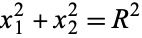
is ![<span style=]() {x in R^n|d(x,0)=1}" src="https://mathworld.wolfram.com/images/equations/Hypersphere/Inline18.gif" style="height:18px; width:121px" />," Maunder 1997, p. 21). A geometer would therefore regard the object described by
{x in R^n|d(x,0)=1}" src="https://mathworld.wolfram.com/images/equations/Hypersphere/Inline18.gif" style="height:18px; width:121px" />," Maunder 1997, p. 21). A geometer would therefore regard the object described by
 |
(2)
|
as a 2-sphere, while a topologist would consider it a 1-sphere and denote it  . Similarly, a geometer would regard the object described by
 |
(3)
|
as a 3-sphere, while a topologist would call it a 2-sphere and denote it  . Extreme caution is therefore advised when consulting the literature. Following the literature, both conventions are used in this work, depending on context, which is stated explicitly wherever it might be ambiguous.
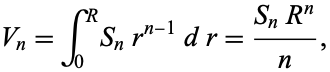
Let  denote the content (i.e.,
  -dimensional volume) of an
  -hypersphere (in the geometer's sense) of radius
  is given by
 |
(4)
|
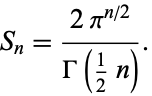
where  is the hyper-surface area of an
  -sphere of unit radius. A unit hypersphere must satisfy
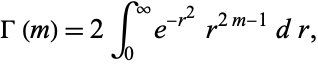
But the gamma function can be defined by
 |
(7)
|
so
![1/2S_nGamma(1/2n)=[Gamma(1/2)]^n=(pi^(1/2))^n](https://mathworld.wolfram.com/images/equations/Hypersphere/NumberedEquation6.gif) |
(8)
|
 |
(9)
|
Special forms of  for
for  an integer allow the above expression to be written as
![S_n=<span style=]() {(2^((n+1)/2)pi^((n-1)/2))/((n-2)!!) for n odd; (2pi^(n/2))/((1/2n-1)!) for n even, " src="https://mathworld.wolfram.com/images/equations/Hypersphere/NumberedEquation8.gif" style="height:98px; width:202px" /> {(2^((n+1)/2)pi^((n-1)/2))/((n-2)!!) for n odd; (2pi^(n/2))/((1/2n-1)!) for n even, " src="https://mathworld.wolfram.com/images/equations/Hypersphere/NumberedEquation8.gif" style="height:98px; width:202px" /> |
(10)
|
where  is a factorial and
  is a double factorial (OEIS A072478 and A072479).

Strangely enough, for the unit hypersphere, the hyper-surface area reaches a maximum and then decreases towards 0 as  increases. The point of maximal hyper-surface area satisfies
![(dS_n)/(dn)=(pi^(n/2)[lnpi-psi_0(1/2n)])/(Gamma(1/2n))=0,](https://mathworld.wolfram.com/images/equations/Hypersphere/NumberedEquation9.gif) |
(11)
|
where 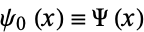 is the digamma function. This cannot be solved analytically for
  , but the numerical solution is
  (OEIS A074457; Wells 1986, p. 67). As a result, the seven-dimensional unit hypersphere has maximum hyper-surface area (Le Lionnais 1983; Wells 1986, p. 60).
In four dimensions, the generalization of spherical coordinates is given by
The equation for the 3-sphere  is therefore
 |
(16)
|
and the line element is
![ds^2=R^2[dpsi^2+sin^2psi(dphi^2+sin^2phidtheta^2)].](https://mathworld.wolfram.com/images/equations/Hypersphere/NumberedEquation11.gif) |
(17)
|
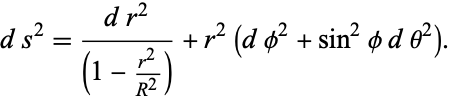
By defining 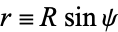 , the line element can be rewritten
 |
(18)
|
The hyper-surface area is therefore given by
REFERENCES:
Collins, G. P. "The Shapes of Space." Sci. Amer. 291, 94-103, July 2004.
Conway, J. H. and Sloane, N. J. A. Sphere Packings, Lattices, and Groups, 2nd ed. New York: Springer-Verlag, p. 9, 1993.
Coxeter, H. S. M. Regular Polytopes, 3rd ed. New York: Dover, 1973.
Hocking, J. G. and Young, G. S. Topology. New York: Dover, 1988.
Le Lionnais, F. Les nombres remarquables. Paris: Hermann, p. 58, 1983.
Maunder, C. M. C. Algebraic Topology. New York: Dover, 1997.
Peterson, I. The Mathematical Tourist: Snapshots of Modern Mathematics. New York: W. H. Freeman, pp. 96-101, 1988.
Sloane, N. J. A. Sequences A072478, A072479, and A074457 in "The On-Line Encyclopedia of Integer Sequences."
Sommerville, D. M. Y. An Introduction to the Geometry of n Dimensions. New York: Dover, p. 136, 1958.
Wells, D. The Penguin Dictionary of Curious and Interesting Numbers. Middlesex, England: Penguin Books, 1986.








