الوضع الليلي


 11:23:7
  2025-07-07
  1871
1871
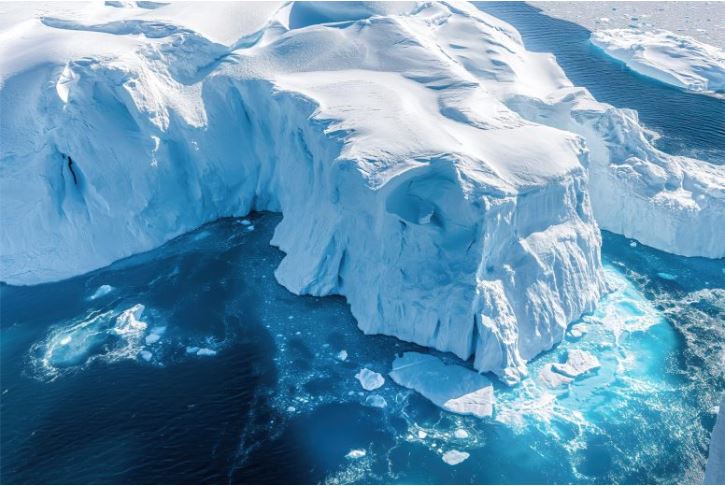
A major shift is unfolding in the waters around Antarctica. Scientists have discovered that the Southern Ocean is getting much saltier — and fast.
This change is allowing deep, hidden heat to rise and melt the sea ice from below. Since 2015, Antarctica has lost as much ice as the entire size of Greenland. Even more striking, a massive hole in the sea ice, unseen for 50 years, has reappeared. The result? Faster warming, stronger storms, and big trouble for wildlife that depends on the ice.
Sudden Southern Ocean Shift
Researchers have discovered a dramatic and unexpected shift in the Southern Ocean, with surface water salinity rising and sea ice in steep decline.
Since 2015, Antarctica has lost sea ice equal to the size of Greenland, the largest environmental shift seen anywhere on Earth in recent decades. The Southern Ocean is also getting saltier, and this unexpected change is making the problem worse.
For decades, the ocean’s surface freshened (becoming less salty), helping sea ice grow. Now, scientists say that trend has sharply reversed.
Salinity Spike Detected by Satellites
Using European satellite data, research led by the University of Southampton has discovered a sudden rise in surface salinity south of 50° latitude.
This has coincided with a dramatic loss of sea ice around Antarctica and the re-emergence of the Maud Rise polynya in the Weddell Sea – a huge hole in the sea ice nearly four times the size of Wales, which hadn’t occurred since the 1970s.
The findings were published on June 30 in the Proceedings of the National Academy of Sciences.
Maud Rise Polynya Reopens
Dr. Alessandro Silvano from the University of Southampton, who led the research, said: “Saltier surface water allows deep ocean heat to rise more easily, melting sea ice from below. It’s a dangerous feedback loop: less ice leads to more heat, which leads to even less ice.
“The return of the Maud Rise polynya signals just how unusual the current conditions are. If this salty, low-ice state continues, it could permanently reshape the Southern Ocean — and with it, the planet. The effects are already global: stronger storms, warmer oceans, and shrinking habitats for penguins and other iconic Antarctic wildlife.”
Feedback Loop Weakens Stratification
In these polar waters, cold, fresh surface water overlays warmer, saltier waters from the deep. In the winter, as the surface cools and sea ice forms, the density difference (stratification) between water layers weakens, allowing these layers to mix and heat to be transported upward, melting the sea ice from below and limiting its growth.
Since the early 1980s, the surface of the Southern Ocean had been freshening, and stratification had been strengthening, trapping heat below and sustaining more sea ice coverage.
Now, new satellite technology, combined with information from floating robotic devices which travel up and down the water column, shows this trend has reversed; surface salinity is increasing, stratification is weakening, and sea ice has reached multiple record lows – with large openings of open ocean in the sea ice (polynyas) returning.
Real-Time Data Upends Expectations
It’s the first time scientists have been able to monitor these changes in the Southern Ocean in real-time.
Contrary to the new findings, man-made climate change was generally expected to sustain Antarctic Sea ice cover over the coming years.
Aditya Narayanan, a postdoctoral research fellow at the University of Southampton and co-author on the paper, explains: “While scientists expected that human-driven climate change would eventually lead to Antarctic Sea ice decline, the timing and nature of this shift remained uncertain.
“Previous projections emphasized enhanced surface freshening and stronger ocean stratification, which could have supported sustained sea ice cover. Instead, a rapid reduction in sea ice—an important reflector of solar radiation—has occurred, potentially accelerating global warming.”
Urgent Call for Continuous Monitoring
Professor Alberto Naveira Garabato, co-author of the study and Regius Professor of Ocean Sciences at the University of Southampton, added: “The new findings suggest that our current understanding may be insufficient to accurately predict future changes.”
“It makes the need for continuous satellite and in-situ monitoring all the more pressing, so we can better understand the drivers of recent and future shifts in the ice-ocean system.”
Reality Of Islam |
|

Plants are
After spend
A study of

Researchers
 9:3:43
2018-11-05
9:3:43
2018-11-05
10 benefits of Marriage in Islam
7:5:22
2019-04-08
benefits of reciting surat yunus, hud &
9:45:7
2018-12-24
advantages & disadvantages of divorce
11:35:12
2018-06-10
6:0:51
2018-10-16
8:3:0
2018-06-21
8:4:21
2022-01-08
1:16:44
2018-05-14
8:25:12
2022-03-09
3:42:22
2021-12-24
8:39:51
2022-09-23
6:28:21
2022-12-20
5:41:46
2023-03-18
| LATEST |
 HOME
HOME