الوضع الليلي


 4:10:53
 2026-07-11
 910
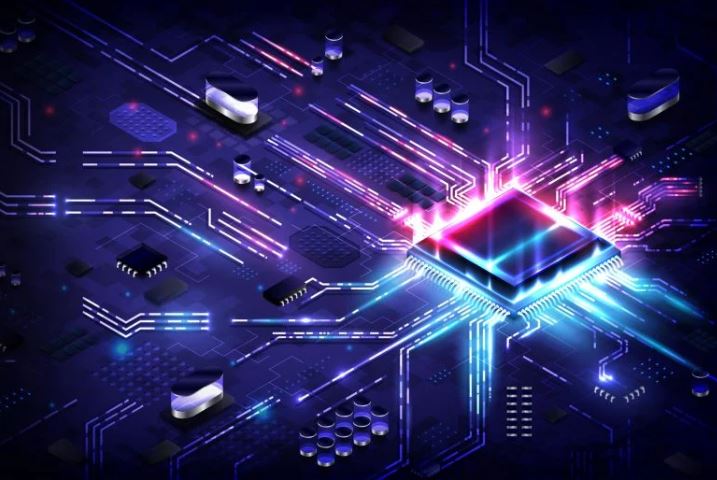
Modern computer chips contain billions of silicon transistors, but silicon is nearing the limits of how small and powerful it can become. To keep improving electronics, scientists are investigating ultrathin materials that could work alongside silicon in future transistors.
One of the most promising options is molybdenum disulfide, a member of a family of atomically thin materials known as transition metal dichalcogenides (TMD). This material is only three atoms thick, consisting of a layer of molybdenum between two layers of sulfur.
Removing a Single Atomic Layer Without Damage
To combine silicon with TMD materials in future chip designs, manufacturers will likely need to remove only the top sulfur layer while leaving everything beneath it untouched.
The standard technique relies on plasma, the energetic state of matter that also makes up the sun and stars and has been a major focus of research at the U.S. Department of Energy’s (DOE) Princeton Plasma Physics Laboratory (PPPL) for the past 75 years.
Under the right conditions, particles within the plasma strike the surface of the TMD, knocking sulfur atoms free. The challenge is achieving enough force to remove the upper sulfur layer without also damaging the molybdenum layer directly underneath. Because the difference between those two outcomes is so small, creating a reliable manufacturing process has remained difficult.
Using computer simulations, the researchers discovered that coating molybdenum disulfide with oxygen or fluorine before plasma treatment dramatically improves that margin for error. Their findings were published in the Journal of Physical Chemistry Letters.
Oxygen and Fluorine Lower the Energy Needed
The simulations showed that removing a sulfur atom from an untreated surface requires about 30 electron volts of energy. That requirement drops to roughly 10 electron volts after a fluorine coating and to about 14 electron volts after an oxygen coating.
This reduction is important because plasma ions naturally carry a range of energies rather than a single precise value. On an untreated surface, the energy needed to remove sulfur is so close to the level that damages the underlying molybdenum that some ions almost inevitably cause unwanted harm.
Lowering the sulfur removal threshold to 10 or 14 electron volts creates a much larger operating window. That gives manufacturers a better chance of removing only the top sulfur layer while preserving the rest of the material.
Letting Chemistry Do the Work
Rather than depending entirely on physical impacts from plasma, the researchers found a way to use chemistry to assist the process.
When a plasma ion strikes an oxygen-coated surface, two oxygen atoms combine with a nearby sulfur atom to form sulfur dioxide, a stable gas that naturally separates from the surface. Fluorine helps in a similar way by creating sulfur-fluorine compounds that are also easier to remove.
“We are not directly breaking the bonds,” said Yury Polyachenko, a graduate student in chemistry at Princeton University who also worked at PPPL during the summer of 2025 and is the study’s lead author. “We are forming some intermediate products, such as sulfur dioxide. This intermediate product is much easier to break off.”
Expanding the Technique to Other Materials
The researchers now want to move beyond simply determining whether damage occurs and instead measure how much damage different processing conditions create.
“The next step is figuring out how much damage the process causes, not just whether it causes damage,” Polyachenko said. “After that, we want to see whether the same approach works for related materials — swapping molybdenum for tungsten, or sulfur for selenium — to find out how broadly this idea can be applied.”
Reality Of Islam |
|
Metal foam

By filling

Scientists
 9:3:43
2018-11-05
10 benefits of Marriage in Islam
7:5:22
2019-04-08
benefits of reciting surat yunus, hud &
9:45:7
2018-12-24
advantages & disadvantages of divorce
11:35:12
2018-06-10
6:0:51
2018-10-16
6:14:3
2023-01-18
3:42:22
2021-12-24
11:2:27
2022-10-06
10:55:53
2022-06-13
al-hussain (peace be upon him)
10:18:1
2022-09-21
5:57:34
2023-03-18
3:43:50
2022-11-05
5:41:46
2023-03-18
| LATEST |
 HOME