Sample preparation and presentation
Liquids can be measured using conventional cuvettes or by transflectance, again using a fibre optic probe fitted with a transflectance tip , or directly on a sample stage in a cup with a suitable reflector . For the measurement of powders, it has been recommended that sample bottles should be filled by ‘pouring’ the powder into the bottle without tapping (Yoon et al., 1998). Tapping causes compaction of the powder and was found to result in poor sample-measurement repeatability. For reflectance measurements, the sample thick ness should be such that any further increase in sample thickness has no effect upon the spec trum. Typically, NIRradiationpenetrates1–3 mm into a powdered sample and a sample thickness of >10 mm is recommended to give an effective ‘infinite thickness’. For a compact material such as a tablet the reflected radiation will penetrate only 0.1–1 mm. The sample bottle diameter should exceed that of the radiation beam. For many instruments, this means a bottle of diam eter of about 10 mm or greater. Samples bottles should be chosen that have smooth bases, other wise specular reflectance varies from one bottle to the next as well as the orientation on the sample stage. The same type of sample bottle should be used for both test samples and refer ence materials to minimise differences due to sampling containers.
Sample-measurement repeatability is very dependent upon the nature of the sample. Liquids and solutions are highly reproducible because of the homogeneous nature of the sample. Crystalline powders usually show poor repeatability because of varying specular reflection from the crystal surfaces. Specular reflection distorts the ‘absorbance’ spectrum and limits the usable photometric range. Identification algorithms can be affected markedly by the crystallinity of samples. Careful crushing of the material to reduce the particle size can help to minimise the effects. Vibrational patterns are affected by differences in the crystal lattice and hence different polymorphs show significant differences in their NIR spectra (Blanco et al. 1998; Patel et al. 2001).
As for analysis in the mid IR region, solvents for the preparation of solutions are somewhat limited for NIR analysis. Only carbon tetrachlor ide and carbon disulfide among the common solvents are transparent throughout the entire NIR region. Methylene chloride, dioxane, heptane, acetonitrile and dimethyl sulfoxide have regions below 2200 nm that can be used.
Water has a particularly strong absorbance spectrum in the NIR region and samples must be protected from uptake or loss of water from or to the atmosphere. The presence of water can be recognised easily by the characteristic absorption peak in the range 1900–1940 nm. The exact peak position depends on the nature of the water free or water of crystallisation – and the extent of hydrogen bonding. The water peak in the spec trum of lactose monohydrate (Fig. 1) can easily be seen.
Intact tablets may be measured as easily as any other sample. A sample bottle that contains tablets randomly packed may be placed on the sample stage or single tablets may be measured directly. The depth of penetration of reflected radiation from compact materials, such as tablets, is limited to only a few tenths of a millimetre. Markings on tablets can affect the spectra and a decision has to be made whether to measure one side or both. With coated tablets it is possible for the reflectance spectrum to be dominated by the coating material, though some radiation will penetrate into the core. Tablets can be crushed and the powder measured in a sample bottle if required.
With grating instruments, spectra commonly exhibit a small anomalous peak known as a Wood’s peak at about 1520 nm. The magnitude of the peak is dependent upon the difference in diameters of the sample and reflectance standard used: the greater the difference, the larger the peak (Fig. 2). It can be quite pronounced in the spectra of poorly absorbing substances and care is required not to confuse the Wood’s peak with peaks from the material. Tablets, which generally have a small diameter, often show a prominent Wood’s peak when they are measured by placing them directly on the sample stage.
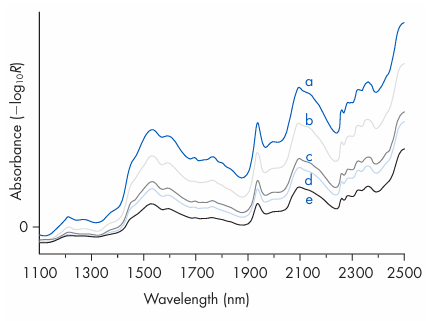
Figure 1 Reflectance spectra of lactose monohydrate of varying particle sizes: (a)>150, (b) 93, (c) 63, (d) 45 and (e) 32 μm. Note the characteristic absorption peak due to water at 1900–1940 nm.
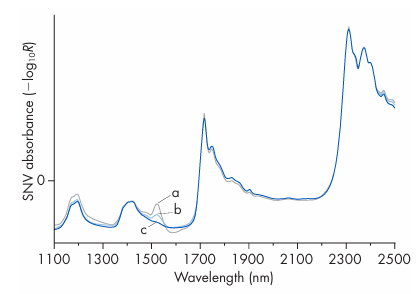
Figure 2 Wood’s anomaly observed with grating monochromator instruments. Reflectance spectra of poly(vinyl chloride) powder measured in sample bottles of different diameters. Bottle diameter: (a) 8 mm, (b) 15 mm and (c) 25 mm. Reference diameter: 50 mm.








