Some Essential Properties of Relative Constructions and Questions in Hindi
In both Hindi and Punjabi, unlike English, relative words and question words are not the same. The former usually begin with a j-sound, whereas the latter begin with a k-sound. There are three possible positions for finite relative clauses in both languages: (1) preceding the main clause (also known as the correlative construction; Dayal 1996), (2) immediately following the head noun (also called embedded relatives), and (3) following the main clause (also called extraposed relatives). In this chapter, I concentrate on embedded relative clauses in both languages.
Unlike in English, in Hindi the relative phrase (rel-phrase) is obligatory. Movement of the relative phrase is possible but not obligatory. If the relativization does not cross a finite CP, native speakers of Hindi al low the relative phrase to remain in situ, as shown in (1a), though they find it more natural to front the relative phrase as in (1b).
(1)

However, if the relativization crosses a finite CP, then the relative phrase must move to the highest CP in the relative clause.
(2)

The examples in (6) indicate that full fronting is required. (2b) shows that the option of rel-in-situ is not available in embedded finite clauses. Neither is the option of partial movement (i.e., rel-phrases are not fully fronted), as shown in (2c).
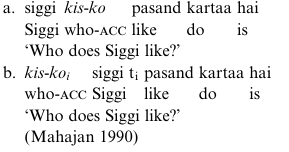
Like movement of the rel-phrase, movement of the wh-phrase in ques tions is possible but not obligatory. (3a) is an example of wh-in-situ, which is more natural to native speakers of Hindi, and (3b) shows a fronted wh-phrase.
(3)
Furthermore, in questions, as in relative clauses, wh-in-situ is not always permitted. If the question formation crosses a finite CP, then the wh phrase must move out of its base-generated position. The wh-phrase in (4a) is in situ in the embedded finite clause and the matrix question reading is unavailable. However, the matrix question reading becomes available when the wh-phrase moves to the matrix clause, as in (4b). The matrix question reading is also possible when an invariant element, kyaa ‘what’, is inserted in the matrix clause while the wh-phrase remains inside the embedded clause (scope-marking strategy), as in (4c).
(4)









