Is There a Position Higher Than the Criterial Position?
Can movement continue when the moved item reaches the first criterial position, or does it have to stop there? In other words, can several criteria be met ‘‘in passing’’ by a single phrase? Analogy with the s-selection position would suggest a negative answer. By symmetry, one would expect that (1) chains begin at an s-selection position and end at a criterial position, and (2) such positions are unique, each chain having exactly (or at most) one position of each kind. Is the analogy correct?
We will now look at some data supporting the analogy and suggesting that, when a criterion is met, the phrase is frozen in place. This issue is rarely addressed in the literature (if at all), so let us consider it systematically. There are four cases to consider:
(1)

A straightforward instantiation of case (1a) is a structure involving both an indirect question and a main question: plainly, the same wh element cannot fulfill the requirements of the indirect question (satisfy the Question Criterion in the embedded C system) and then move on to the main C system. Given (2a) as an intermediate step, it is not possible to derive (31b), with representation (2c) in terms of the copy theory of traces.
(2)

To the best of my knowledge, this is the only case of (1) discussed in the literature (e.g., Lasnik and Saito 1992). In terms of the approach and terminology used here, it suggests that the creation of a criterial configuration freezes the structure, and the wh-phrase involved is not accessible to further movement. In other words, a constraint like this holds:
(3)

Principle (3) can be thought of as an economy condition that contributes to minimizing movement (hence a component of the formal implementation of the concept ‘‘movement as a last resort’’) and determines optimally simple chains with unique occurrences of the fundamental ingredients: unique y-role (or s-selection licensing), unique scope-discourse marking, and so on.
Is (3) an independent formal principle, or does it follow from other properties of syntactic computations or of the interface systems? Case (2b–c) could be ruled out for purely interpretive reasons, as it does not seem to be amenable to any sound logical form. But if we turn to the other cases of (1), the interpretive approach does not seem to be generalizable.
Consider (1b). A possible instantiation would be a phrase bearing both the Q-feature and the (contrastive) focus feature. In languages like Italian, contrastive focus may be associated to an element in situ, as in (4a), or may involve movement of the element to the left periphery, as in (4b). (Contrastive stress is expressed by capitalization in the following examples.)
(4)

Now, a wh-phrase in an embedded question can be contrastively focused in its criterial position, in the embedded C system, but it cannot be moved to the left periphery of the main clause.
(5)

As contrastive focus is clearly compatible with a wh-phrase (see (5a)), it does not seem plausible to assume that (5b) is ruled out for interpretive reasons.
Case (1c) is illustrated by a complex phrase whose elements bear two-features of the same kind—say, two Q-features. An example is [quanti libri di quale autore] ‘how many books by which author’. Suppose this complex phrase is inserted in a structure involving both a main and an embedded question. Consider an abstract configuration like (6). (Here and in what follows, for the sake of simplicity I use old-style derivations with movement applying on completely formed structures; nothing hinges on this.)
(6)

Here, the only (marginally) possible grammatical output is the one in which the complex wh-phrase splits, and in a specific order: the whole wh-phrase moves to the embedded C system, yielding (7a), and then the most deeply embedded phrase, di quale autore ‘by which author’, is further extracted to the main C system, yielding the marginally acceptable (7b).
(7)

The complex wh-phrase cannot split in the opposite order. That is, as (8) shows, it is impossible to first extract the most deeply embedded sub phrase di quale autore to the embedded C system and then move the remnant of the complex phrase to the main C system.
(8)

That the splitting can take place in only one way is an interesting observation that calls for an explanation. It presumably bears on the constraints on remnant movement; I assume it to be orthogonal to the present discussion.
But the relevant point here is that the splitting must take place. It is not possible to move the large phrase to the embedded C system and then move it on to the main C system.
(9)


Why is this derivational option not viable? Notice that the lower wh element is able to pied-pipe the whole phrase from an embedded declarative, at least marginally.
(10)
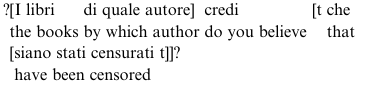
Again, the impossibility of (9b) suggests that criteria cannot be satisfied in passing; hence, something like constraint (3) is operative. No interpretive problem seems to arise here: (9b) should receive the same logical form as (7b), obtainable under reconstruction (in fact, directly provided by the copy theory of traces).
Notice that (9b) significantly improves if the embedded C is filled by a yes/no complementizer (se ‘whether’).
(9)

In fact, (9b) expresses a completely different structure from (38b): here, the Question Criterion is fulfilled by se (and/or a null yes/no opera tor) in the indirect question, and the complex wh-phrase is construed with the main C system as a multiple main question. The complex wh phrase has passed through whatever escape hatch is available in the embedded C system in cases of extraction from a wh-island, where it is not involved in criterial satisfaction; the marginality of the example is due to the wh-Island and to whatever factor disfavors multiple questions in Italian (Rizzi 1982, chap. 2), but Criterial Freezing is not involved.
The same argument provided by (9b) can be constructed with a complex phrase containing both an interrogative and a relative element [quanti libri del quale] ‘how many books by whom(rel)’. Starting from a configuration like (10a), and after moving the complex phrase to the interrogative C system, as in (10b), it is necessary to split the complex phrase, as in (11a); pied-piping the whole phrase to the relative C system, as in (11b), yields a sharply ungrammatical result. I assume that a Relative Criterion causes movement in relative clauses (see Bianchi 1999 for a more fine-grained approach); for concreteness, in the following examples I call the feature attracting the relative phrase R.
(10)
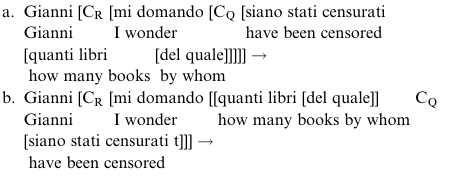
(11)

In the case of appositive relatives, the pied-piping of complex phrases by a deeply embedded relative pronoun is quite tolerable in other structures, as in (12b).
(12)

What goes wrong in (11b), then, is not heavy pied-piping per se but the attempt to satisfy a criterion in passing.
In fact, in some cases an even heavier pied-piping is marginally tolerable, provided that no criterial configuration is undone. Consider the following paradigm:
(13)

Here, given an abstract representation like (14a), after the complex phrase quanti libri del quale has moved to the Spec,CQ of the indirect question, yielding intermediate representation (14b), it is possible for the complex phrase to split, with movement of del quale alone to the relative C system, giving rise to (13a).
(14)

It is not possible to continue the derivation from (14b) by pied-piping quanti libri del quale to the CR system; this would derive the sharply ungrammatical (13b), a violation of Criterial Freezing. But there is another (marginal) derivational option from (14b): the whole indirect question can be pied-piped to Spec,CR, yielding (13c). The steps involved in this derivation are repeated here:
(15)


In this case, the complex phrase quanti libri del quale does not have to split because the Question Criterion and the Relative Criterion are satisfied by distinct phrases (the Question Criterion by the complex nominal phrase quanti libri del quale and the Relative Criterion by the whole indirect question quanti libri del quale siano stati censurati containing the complex nominal phrase); no satisfaction in passing is involved, and principle is thus respected. Clausal pied-piping is a very marginal phenomenon in Italian (though quite common in other languages, such as Basque; Ortiz de Urbina 1989), whence the status of (13c). But the crucial point is that there is a clearly detectable difference between the marginality of (13c) and the full ungrammaticality induced by a violation of Criterial Freezing in cases like (13b). Again, interpretive considerations seem to be irrelevant to rule out the crucial cases (11b) and (13b).
In conclusion, the evidence presented in this section supports the view that there is a certain symmetry between s-selection and criterial positions. Consider the principles introduced here:
S-selection is fulfilled by first Merge.
A phrase meeting a criterion is frozen in place.
To stress the symmetry with (1), we could restate (2) as (3).
A criterion is fulfilled by last Merge.
Both kinds of positions appear to be unique in chains and serve to delimit them: s-selection positions initiate chains (of all kinds); criterial positions terminate (A ¯-)chains.
We should ask why uniqueness is guaranteed in the way expressed by (1) and (2) (or (3)): couldn’t natural languages work the other way around, with scope-discourse properties expressed in first Merge positions and s-selection properties expressed by last Merge? Notice that s-selection is typically a property of lexical elements, while scope-discourse or criterial semantics is typically expressed by a system of functional heads. The particular way in which (1) and (2) ensure uniqueness thus seems to reflect the fact that lexical layers are generally embedded under functional layers, not the other way around.








