LIAISONS (JOINING)
If you have ever listened to people speaking a foreign language that was unknown to you, you may have noticed that it was impossible to pick out individual words from the string of sounds that you heard. This is because, in real connected speech, words are linked to one another. This is an especially important phenomenon in RP where the phoneme /r/ does not occur in syllable final position unless the word with a final 'r' is followed by a word beginning with a vowel. Furthermore, when two vowels meet over a word boundary, an extra letter is frequently added in order to help the transition. While /r/ is the most common linking sound, /w/ and /j/ can also be activated between two vowels. This kind of liaison in which a sound segment is inserted between two other sound segments to differentiate between them is often called dissimilation.
Dissimilation is the opposite of assimilation. One example of linking is to re activate an /r/ sound:
e.g., the teacher of the school /ðə’ti:ʧərəvðə’sku:l/.
Another example of linking is to insert an /r/ between two vowels:
e.g., the idea of /ðə’aɪdɪərəv/.
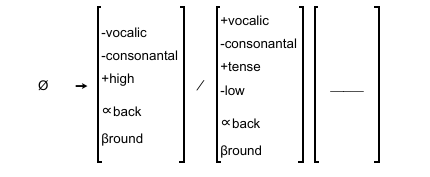
Linking is not limited to the /r/ sound it can also be used by /j/ and /w/. for example, in English the [+tense, -low] vowels [i:, e, u:, ɔ:] are predictably followed by a glide:
In American English, words are not pronounced one by one. Usually, the end of one word attaches to the beginning of the next word. This is also true for initials, numbers, and spelling. Part of the glue that connects sentences is an underlying hum or drone that only breaks when you come to a period, and sometimes not even then. You have this underlying hum in your own language and it helps a great deal toward making you sound like a native speaker. Once you have a strong intonation, you need to connect all sounds together so that each sentence sounds like one long word.
The dime easier
They tell me the dime easier.
They tell me the dime easier to understand.
They tell me that I'm easier to understand.
The last two sentences above should be pronounced exactly the same, no matter how they are written. It is the sound that is important, not the spelling. This stringing together of sounds is usually called liaison. There are four main points where liaisons happen in English: (a) when consonants are followed by vowels; (a) when consonants are followed by other consonants; (c) when vowels are followed by other vowels; and (d) when /t/, /d/, /s/, and /z/ are followed by /j/.








