CONCEPTUALISING WHAT WE THINK, PERCEIVE AND FEEL
MENTAL PROCESSES
Not all situations that we wish to express linguistically centre on doings and happenings. Mental processes are those through which we organize our mental contact with the world. There are four main types: cognition, such as know, understand, believe, doubt, remember and forget; perception, encoded by verbs such as see, notice, hear, feel and taste; affectivity, such as like, love, admire, miss and hate; desideration such as hope, want, desire and wish. Some of these are illustrated in the following invented sequence:
Tom saw a ball in the tall grass. He knew it wasn’t his, but he wanted to get it. He didn’t realize there were lots of nettles among the grass. He soon felt his hands stinging. He wished he had noticed the nettles.
With mental processes it makes no sense, as it does with material processes, to talk about who is doing what to whom. In, for example, Jill liked the present, Jill is not doing anything, and the gift is not affected in any way. We can’t apply the ‘doing to’ test to processes of liking and disliking, asking for instance ‘What did Jill do to the present?’ In many cases, a better test is to question the Experiencer’s reaction to something. It is therefore inappropriate to call Jill an Agent and the present the Affected. Rather, we need two more semantic roles:

The Experiencer (or Senser) is the participant who sees, feels, thinks, likes, etc., and is typically human, but may also be an animal or even a personified inanimate object (The rider heard a noise, the horse sensed danger, your car knows what it needs). The use of a non-conscious entity as Experiencer in a mental process is often exploited for commercial ends, as in this last example.
The second participant in a mental process, that which is perceived, known, liked, etc., is called the Phenomenon. Mental processes are typically stative and non- volitional. When they occur in the present tense they typically take the simple, rather than the progressive, form. Compare this feature with material process verbs, for which the more usual, ‘unmarked’ form for expressing a happening in the present is the progressive. Another feature of stative verbs is that they do not easily occur in the imperative (Know thyself is a famous exception).

Mental processes can sometimes be expressed with the Phenomenon filling the Subject slot and the Experiencer as Object, although not necessarily by means of the same verb. This means that we have two possible construals of the mental experience: in the one case, the human participant reacts to a phenomenon, as in 1 and 2, while in the other the phenomenon activates the attention of the experiencer, as in 3 and 4. Reversibility is helped by the fact that the passive is possible with many mental processes:
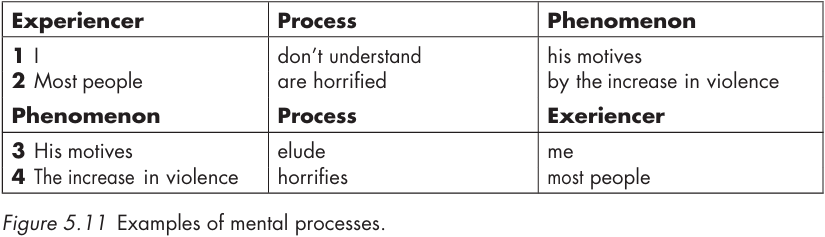
Similarly, English has the verb please, which is used occasionally in this way: I don’t think her choice pleased her mother [931]. More often ‘pleased’ is used as an adjective, as in he was very pleased with himself, which adjusts to the predominant pattern by which human subjects are preferred to non-human ones. ‘Pleased’ also tends to be equivalent to ‘satisfied’ or polite ‘willing’ as in University officers will be pleased to advise anyone . . . [931], which is quite different affectively from ‘like’.
In all the examples so far, the Phenomenon has been a single entity, expressed as a nominal group as the Object of the verb. But it can also be a fact, a process or a whole situation, realized by a clause, as in the following examples:









