ANALYTICAL CAUSATIVES WITH A RESULTING ATTRIBUTE
One final type of causative we will consider is the analytical type, based on combinations with verbs such as make and turn. In these an Agent brings about a change of state in the Affected participant. The resulting state is expressed by an Attribute (Complement of the Object in a syntactic analysis).
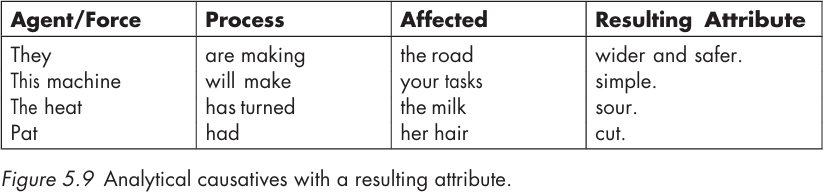
The resulting change of state in the Affected participant is sometimes part of the meaning of a morphologically related causative verb: widen is the equivalent of make wide and simplify means make simple. With such verbs there are alternative SPOd causative structures: They are widening the road; This machine will simplify your tasks. For other adjectives such as safe there is no corresponding causative verb. Certain dynamic verbs such as turn can be used in specific causative senses in English. Have introduces a passive sense, expressed by a participle (cause to be -en).
Intransitives and transitive-causatives are illustrated in the following text:
Suddenly there was no sunshine. It went out,1 as if someone had blown out the sun like a lamp.2 The outdoors was grey, the windowpanes were grey, and at the same moment a wind crashed against the schoolhouse,3 rattling windows and doors4 and shaking the walls.5
(Laura Ingalls Wilder, The Long Winter)
1intransitive; 2causing the Affected participant (the sun) to undergo an action (be blown out); 3Force (a wind), intransitive (crashed); 4indirectly caused the Affected (windows and doors) to rattle; and 5causing the Affected (the walls) to undergo an action (shake).








