Grammar
Tenses
Present

Present Simple
Present Continuous
Present Perfect
Present Perfect Continuous
Past
Past Simple
Past Continuous
Past Perfect
Past Perfect Continuous
Future
Future Simple
Future Continuous
Future Perfect
Future Perfect Continuous
Parts Of Speech
Nouns
Countable and uncountable nouns
Verbal nouns
Singular and Plural nouns
Proper nouns
Nouns gender
Nouns definition
Concrete nouns
Abstract nouns
Common nouns
Collective nouns
Definition Of Nouns
Animate and Inanimate nouns
Nouns
Verbs
Stative and dynamic verbs
Finite and nonfinite verbs
To be verbs
Transitive and intransitive verbs
Auxiliary verbs
Modal verbs
Regular and irregular verbs
Action verbs
Verbs
Adverbs
Relative adverbs
Interrogative adverbs
Adverbs of time
Adverbs of place
Adverbs of reason
Adverbs of quantity
Adverbs of manner
Adverbs of frequency
Adverbs of affirmation
Adverbs
Adjectives
Quantitative adjective
Proper adjective
Possessive adjective
Numeral adjective
Interrogative adjective
Distributive adjective
Descriptive adjective
Demonstrative adjective
Pronouns
Subject pronoun
Relative pronoun
Reflexive pronoun
Reciprocal pronoun
Possessive pronoun
Personal pronoun
Interrogative pronoun
Indefinite pronoun
Emphatic pronoun
Distributive pronoun
Demonstrative pronoun
Pronouns
Pre Position
Preposition by function
Time preposition
Reason preposition
Possession preposition
Place preposition
Phrases preposition
Origin preposition
Measure preposition
Direction preposition
Contrast preposition
Agent preposition
Preposition by construction
Simple preposition
Phrase preposition
Double preposition
Compound preposition
prepositions
Conjunctions
Subordinating conjunction
Correlative conjunction
Coordinating conjunction
Conjunctive adverbs
conjunctions
Interjections
Express calling interjection
Phrases
Sentences
Clauses
Part of Speech
Grammar Rules
Passive and Active
Preference
Requests and offers
wishes
Be used to
Some and any
Could have done
Describing people
Giving advices
Possession
Comparative and superlative
Giving Reason
Making Suggestions
Apologizing
Forming questions
Since and for
Directions
Obligation
Adverbials
invitation
Articles
Imaginary condition
Zero conditional
First conditional
Second conditional
Third conditional
Reported speech
Demonstratives
Determiners
Direct and Indirect speech
Linguistics
Phonetics
Phonology
Linguistics fields
Syntax
Morphology
Semantics
pragmatics
History
Writing
Grammar
Phonetics and Phonology
Semiotics
Reading Comprehension
Elementary
Intermediate
Advanced
Teaching Methods
Teaching Strategies
Assessment

Aspect
 المؤلف:
Mark Aronoff and Kirsten Fudeman
المؤلف:
Mark Aronoff and Kirsten Fudeman
 المصدر:
What is Morphology
المصدر:
What is Morphology
 الجزء والصفحة:
P214-C7
الجزء والصفحة:
P214-C7
 2026-04-21
 24
24


+
-
20
Aspect
Kujamaat Jóola does not have a tense system that expresses time-related notions like ‘past’ and ‘present’ directly.1 Instead, it has an aspectual system. This means that it expresses notions such as duration, completeness, and doubt, which have more to do with the nature of the action of the verb or with the speaker’s attitude than with time. The unmarked form of the verb can be interpreted as either present or past, as seen in (5):

The suffix -ε:n, the so-called dubitive-incompletive, is used to indicate that an action has not been completed (much like the imperfect aspect familiar from English or the Romance languages) or that it is in doubt.2 In (6), the final /n/ of the past absolute suffix assimilates in place with the following labial stop, surfacing as [m]:

In (6), it is understood that the subject no longer has money. Thomas and Sapir (1967) present another example: Fuken nij••njaw kabaak, εmitey dεs ɔfɔm məniləñu ‘Yesterday I was going to Kabâk, but the rain overtook me (en route) and I returned (without getting there).’ Here the verb nijεεn jaw (jεεn < -jaw-ε:n ‘go’ + INC) ‘was going’ indicates that the action of going was not completed. Without the dubitive-incompletive marker, this sentence would mean instead that the subject went to Kabâk despite the rain.
The dubitive-incompletive marker -ε:n may co-occur with other position-1 suffixes. It may precede or follow -εrit (habitual negative), -ut (negative), ɔrut ‘not yet’, ɔrulɔ:t ‘toward speaker’ (negative), and -ulɔ ‘toward speaker’. This fact suggests that they are in the same position. However, it always precedes the other variants of -ulɔ, -u, and -ul, as well as the habitual marker -ε and the second portion of the first person plural inclusive subject circumfix -a ̴-al.
Doubling the dubitive-incompletive marker emphasizes it. Such doubling occurs only in contrastive constructions. This is a good illustration of compositional semantics: it is as though each suffix contributes a degree of meaning:
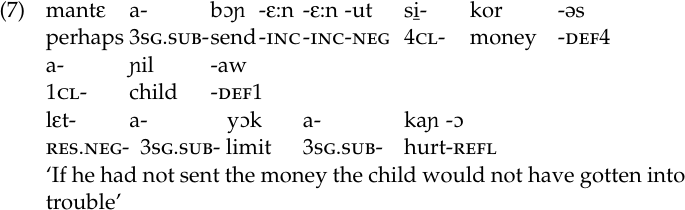
We learned immediately above that there is some flexibility regarding the placement of the dubitive-incompletive suffix -ε:n with respect to other first-position suffixes. The second member of the emphatic construction -ε:n … -ε:n is even more flexible: it may be placed anywhere with respect to the first-position suffixes except directly after the habitual -ε.3 It can even follow an object pronoun.
Future in Kujamaat Jóola is expressed by using the resultative and resultative negative markers pan- and lε-∼lεt-, which appear outside of inflectional morphology for subject, as we see in the following examples (the /-n/ of pan- is dropped before nasals):
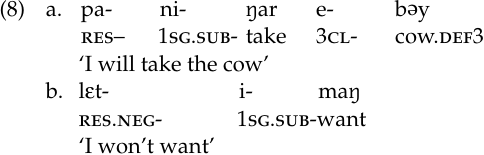
In relative clauses, the future is expressed by a resultative clitic pi that combines with the marker agreeing with the relativized subject or object (Sapir 1965: 92). We see this in (9):

Lastly, combining the dubitive-incompletive suffix with the resultative prefix lεt-, a negative marker, results in a construction that indicates an action that missed taking place or that will not be accomplished. We might translate it as ‘might have’ or ‘might not have’.

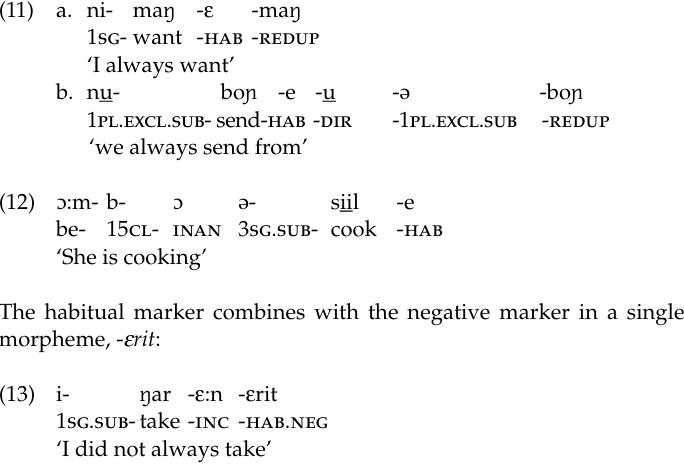
The Kujamaat habitual marker is seen in (11). Gero and Levinsohn (1993) point out that it has a progressive use as well, in which case it occurs with the verb ‘be’ (12) (example from Gero and Levinsohn 1993: 82):
1 Neither does English, in fact.
2 In Sapir (1965), the suffix -ε:n is considered a past marker, and its reduplicated form, which we learn below is emphatic dubitive-incompletive, is considered an indicator of remote past. He revises this analysis in his 1967 paper.
3 This is probably due to a phonological constraint against superlong vowels, which we would have if the habitual e were to merge with ε:n. Furthermore, if the illicit sequence */ε+ε:n/ were to be reduced to /ε:n/, the habitual meaning would be unrecoverable.
 الاكثر قراءة في Morphology
 اخر الاخبار
اخبار العتبة العباسية المقدسة

الآخبار الصحية


مواضيع ذات صلة
 قسم الشؤون الفكرية يصدر كتاباً يوثق تاريخ السدانة في العتبة العباسية المقدسة
 "المهمة".. إصدار قصصي يوثّق القصص الفائزة في مسابقة فتوى الدفاع المقدسة للقصة القصيرة
 (نوافذ).. إصدار أدبي يوثق القصص الفائزة في مسابقة الإمام العسكري (عليه السلام)