Grammar
Tenses
Present

Present Simple
Present Continuous
Present Perfect
Present Perfect Continuous
Past
Past Simple
Past Continuous
Past Perfect
Past Perfect Continuous
Future
Future Simple
Future Continuous
Future Perfect
Future Perfect Continuous
Parts Of Speech
Nouns
Countable and uncountable nouns
Verbal nouns
Singular and Plural nouns
Proper nouns
Nouns gender
Nouns definition
Concrete nouns
Abstract nouns
Common nouns
Collective nouns
Definition Of Nouns
Animate and Inanimate nouns
Nouns
Verbs
Stative and dynamic verbs
Finite and nonfinite verbs
To be verbs
Transitive and intransitive verbs
Auxiliary verbs
Modal verbs
Regular and irregular verbs
Action verbs
Verbs
Adverbs
Relative adverbs
Interrogative adverbs
Adverbs of time
Adverbs of place
Adverbs of reason
Adverbs of quantity
Adverbs of manner
Adverbs of frequency
Adverbs of affirmation
Adverbs
Adjectives
Quantitative adjective
Proper adjective
Possessive adjective
Numeral adjective
Interrogative adjective
Distributive adjective
Descriptive adjective
Demonstrative adjective
Pronouns
Subject pronoun
Relative pronoun
Reflexive pronoun
Reciprocal pronoun
Possessive pronoun
Personal pronoun
Interrogative pronoun
Indefinite pronoun
Emphatic pronoun
Distributive pronoun
Demonstrative pronoun
Pronouns
Pre Position
Preposition by function
Time preposition
Reason preposition
Possession preposition
Place preposition
Phrases preposition
Origin preposition
Measure preposition
Direction preposition
Contrast preposition
Agent preposition
Preposition by construction
Simple preposition
Phrase preposition
Double preposition
Compound preposition
prepositions
Conjunctions
Subordinating conjunction
Correlative conjunction
Coordinating conjunction
Conjunctive adverbs
conjunctions
Interjections
Express calling interjection
Phrases
Sentences
Clauses
Part of Speech
Grammar Rules
Passive and Active
Preference
Requests and offers
wishes
Be used to
Some and any
Could have done
Describing people
Giving advices
Possession
Comparative and superlative
Giving Reason
Making Suggestions
Apologizing
Forming questions
Since and for
Directions
Obligation
Adverbials
invitation
Articles
Imaginary condition
Zero conditional
First conditional
Second conditional
Third conditional
Reported speech
Demonstratives
Determiners
Direct and Indirect speech
Linguistics
Phonetics
Phonology
Linguistics fields
Syntax
Morphology
Semantics
pragmatics
History
Writing
Grammar
Phonetics and Phonology
Semiotics
Reading Comprehension
Elementary
Intermediate
Advanced
Teaching Methods
Teaching Strategies
Assessment

Direct quotation
 المؤلف:
PAUL R. KROEGER
المؤلف:
PAUL R. KROEGER
 المصدر:
Analyzing Grammar An Introduction
المصدر:
Analyzing Grammar An Introduction
 الجزء والصفحة:
P226-C12
الجزء والصفحة:
P226-C12
 2026-01-23
 183
183


+
-
20
Direct quotation
Direct quotes are actually not complements at all. As Weber (1989:20) points out (speaking of Huallaga Quechua), “Direct quotations are embedded in, but not subordinate to, the. . .clause that frames them.” And: “they bear no grammatical relation (e.g. subject, object, etc.) to any verb. ”A direct quotation is, in fact, a separated is course, and may contain any amount of linguistic material from a single word to an entire story.
Haiman (1992) states: “It has been widely noted that quoted material is grammatically independent” of the matrix clause. For example, even though the quote formula in English of ten contains the transitive verb say, the quote itself does not behave like a normal direct object. In(24a) the object of say has been fronted with subject–Aux inversion; but this construction is impossible with a direct quote (24b).
(24) a Not a word did she say.
b “Not a word,” she said/ *did she say.
Haiman uses the examples in (25) to illustrate the principle that quoted words are “mentioned” rather than “used.”
(25) a I don’t like myself.
b I don’t like “I” in essays.
The first-person pronoun which appears as the direct object in (25a) is used in the normal way, to refer to the speaker. Since it is co-referential with the subject of its clause, a reflexive form (myself) must be used. The quoted pronoun “I” in(25b) does not appear in the reflexive, or even the accusative (me), because it is not being used as a pronoun at all; it refers to a word (I) rather than a person (the speaker). When we use a direct quote, we are reporting the linguistic expressions used by a speaker, rather than the content or message which the speaker expressed. As a result, there is generally no grammatical linkage between our words (the quote formula) and the speaker’s words (the quotation).
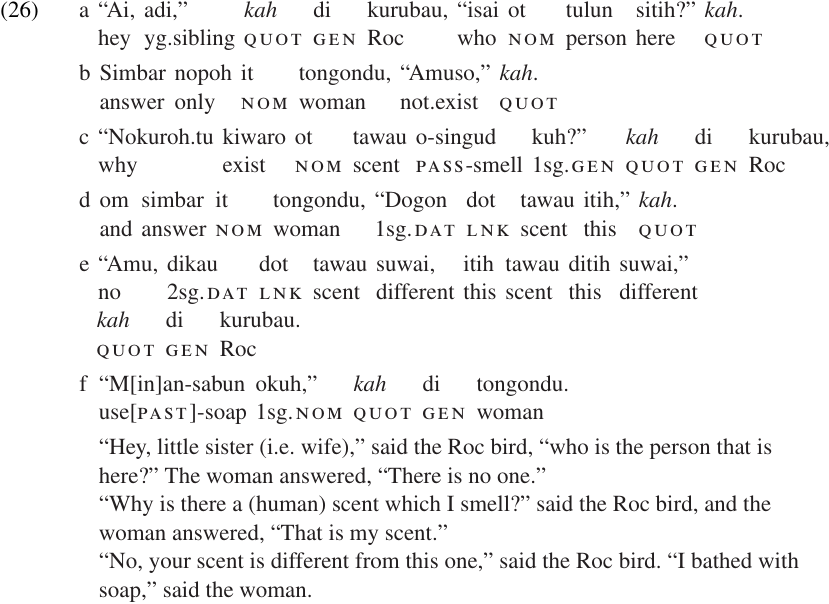
While many languages (including English) use verbs of speaking in the quote formula, this is not always the case. In Kimaragang Dusun, a quote formula need not contain any verb at all, but almost always contains a quotative particle kah. This particle is neither a verb nor a noun: it is only one syllable long, whereas the minimum length for a content word in Kimaragang is two syllables; it cannot take any verbal affixes; and it ends in an–h (indicating lack of a final glottal stop), which is exceedingly rare for content words but quite common among discourse particles and other functors.
The speaker may be indicated by a genitive NP or pronoun following the quote particle, as illustrated in (26). Only in clauses (b) and (d) does the quote formula contain a verb; in both cases the verb is simbar ‘answer,’ though, of course, many other verbs of speaking are possible. This passage is an excerpt from a story about the Roc, or Bird of Vishnu (Malay: Garuda), who abducts a woman to keep her from marrying her suitor.
 الاكثر قراءة في Direct and Indirect speech
 اخر الاخبار
اخبار العتبة العباسية المقدسة

الآخبار الصحية


 قسم الشؤون الفكرية يصدر كتاباً يوثق تاريخ السدانة في العتبة العباسية المقدسة
 "المهمة".. إصدار قصصي يوثّق القصص الفائزة في مسابقة فتوى الدفاع المقدسة للقصة القصيرة
 (نوافذ).. إصدار أدبي يوثق القصص الفائزة في مسابقة الإمام العسكري (عليه السلام)