We have learned that when a wire is carried through a magnetic field, cutting the lines of force, a current is generated in the wire. The converse of this is also true: if a current is sent through a wire that is in a magnetic field, the wire will be set in motion in a direction contrary to that which would have produced the current. In general any dynamo is reversible and can be used as a motor.
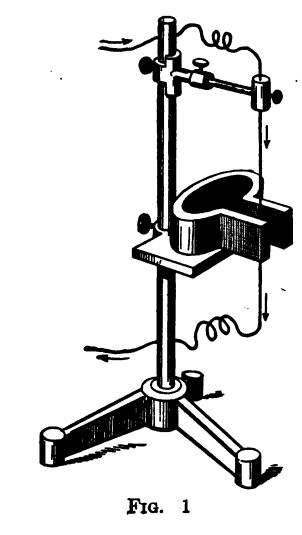
Demonstration. - Support a horseshoe magnet having a strong magnetic field in a horizontal position as shown in Fig. 1. Send a current through a No. 30 copper wire that is hanging vertically between the poles. As soon as the current is turned on, the wire will move out from between the poles, and if the current is strong enough, it will swing around to the outside of the N pole. The reason for the motion of the wire is seen if we apply the law of the mutual action of magnetic lines of force to the magnetic field around the wire when it is between the poles of the magnet. Let Fig. 2 represent a horizontal section through the wire and magnet.

The direction of the lines of force will be indicated by the arrow points for both the permanent and temporary fields. On the left of the wire the lines of force are in the same direction and the repulsion between them pushes the movable wire to the right.
If we apply the same law to the mutual action between the two sets of lines of force in the air gap of a motor, the cause of the rotation of the motor will be explained. Let Fig. 3

represent a single turn of wire in the air gap. The direction of the lines of force generated around the conductor by a current that is approaching the observer, as on the right side of the figure, is counter-clockwise. The reaction between these lines of force and those generated by the field magnets will be repulsion above the wire, since the lines of force there have the same direction, and attraction below it, since the lines of force there have opposite directions. The result is a tendency to drag the wire downward.
The direction of the lines of force around the wire on the left side of the figure, in which the current is going away from the observer, is clockwise, hence there is repulsion below the wire and attraction above if. The result of this magnetic drag is a clockwise rotation of the armature.








