Grammar
Tenses
Present

Present Simple
Present Continuous
Present Perfect
Present Perfect Continuous
Past
Past Simple
Past Continuous
Past Perfect
Past Perfect Continuous
Future
Future Simple
Future Continuous
Future Perfect
Future Perfect Continuous
Parts Of Speech
Nouns
Countable and uncountable nouns
Verbal nouns
Singular and Plural nouns
Proper nouns
Nouns gender
Nouns definition
Concrete nouns
Abstract nouns
Common nouns
Collective nouns
Definition Of Nouns
Animate and Inanimate nouns
Nouns
Verbs
Stative and dynamic verbs
Finite and nonfinite verbs
To be verbs
Transitive and intransitive verbs
Auxiliary verbs
Modal verbs
Regular and irregular verbs
Action verbs
Verbs
Adverbs
Relative adverbs
Interrogative adverbs
Adverbs of time
Adverbs of place
Adverbs of reason
Adverbs of quantity
Adverbs of manner
Adverbs of frequency
Adverbs of affirmation
Adverbs
Adjectives
Quantitative adjective
Proper adjective
Possessive adjective
Numeral adjective
Interrogative adjective
Distributive adjective
Descriptive adjective
Demonstrative adjective
Pronouns
Subject pronoun
Relative pronoun
Reflexive pronoun
Reciprocal pronoun
Possessive pronoun
Personal pronoun
Interrogative pronoun
Indefinite pronoun
Emphatic pronoun
Distributive pronoun
Demonstrative pronoun
Pronouns
Pre Position
Preposition by function
Time preposition
Reason preposition
Possession preposition
Place preposition
Phrases preposition
Origin preposition
Measure preposition
Direction preposition
Contrast preposition
Agent preposition
Preposition by construction
Simple preposition
Phrase preposition
Double preposition
Compound preposition
prepositions
Conjunctions
Subordinating conjunction
Correlative conjunction
Coordinating conjunction
Conjunctive adverbs
conjunctions
Interjections
Express calling interjection
Phrases
Sentences
Clauses
Part of Speech
Grammar Rules
Passive and Active
Preference
Requests and offers
wishes
Be used to
Some and any
Could have done
Describing people
Giving advices
Possession
Comparative and superlative
Giving Reason
Making Suggestions
Apologizing
Forming questions
Since and for
Directions
Obligation
Adverbials
invitation
Articles
Imaginary condition
Zero conditional
First conditional
Second conditional
Third conditional
Reported speech
Demonstratives
Determiners
Direct and Indirect speech
Linguistics
Phonetics
Phonology
Linguistics fields
Syntax
Morphology
Semantics
pragmatics
History
Writing
Grammar
Phonetics and Phonology
Semiotics
Reading Comprehension
Elementary
Intermediate
Advanced
Teaching Methods
Teaching Strategies
Assessment

Semantic roles and Grammatical Relations
 المؤلف:
PAUL R. KROEGER
المؤلف:
PAUL R. KROEGER
 المصدر:
Analyzing Grammar An Introduction
المصدر:
Analyzing Grammar An Introduction
 الجزء والصفحة:
P51-C4
الجزء والصفحة:
P51-C4
 2025-12-12
 768
768


+
-
20
Semantic roles and Grammatical Relations
The Phrase Structure model is a very useful tool for analyzing sentences. However, as we will see here, Phrase Structure rules by themselves cannot provide an adequate account of what speakers say. For example, the simple set of Phrase Structure rules can produce odd sentences like those in (1) and (2).
(1) a #The young sausage likes the white dog.
b #Mary sings a white cake.
c #Asmall dog gives Mary to the young tree.
(2) a *John likes.
b *Mary gives the young boy.
c *The girl yawns Mary.
Even though the rules seem consistent with what we know about the grammar of English, we see that they can produce unacceptable sentences. These sentences are unacceptable for different reasons. The # sign before the sentences in (1) indicates that they are semantically ill-formed, i.e. they cannot be given an acceptable semantic interpretation. The * sign before the sentences in (2) indicates that they are ungrammatical. In (2a, b) we feel there is a phrase missing, while (2c) seems to contain an extra phrase.
We will discuss these problems in detail in Lexical entries and well-formed clauses. For now the important point is that even though the Phrase Structure rules themselves may be correct, this will not necessarily ensure that the output of the rules is grammatical. Additional information is needed, information about the specific words which are used. This kind of information must be stored in the lexicon in some way.
Another type of complication that can arise is illustrated in (3). The PS rules could generate this sentence in two different ways. This means that the rules assign more than one possible Phrase Structure for this sentence, as shown by the two tree diagrams in (4). These two structures correspond to two different interpretations of the sentence. Can you identify the meanings which would be associated with these two structures?
(3) John pinches the young girl behind the tree.
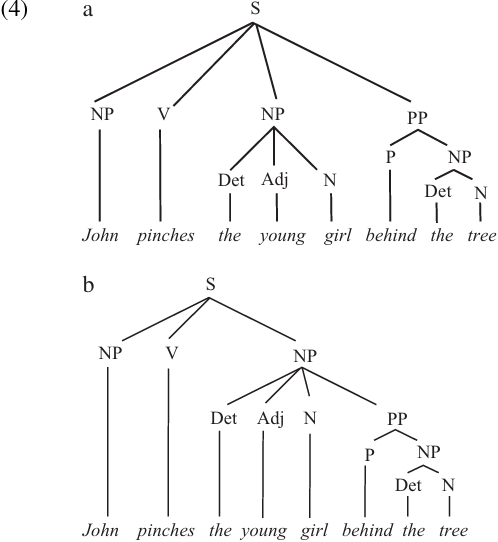
The sentence in (3) is an example of STRUCTURAL AMBIGUITY; the sentence as a whole is ambiguous because it has two possible Phrase Structures, even though none of the individual words is ambiguous in this context.1 Is it some problem with our PS rules that allows the same sentence to be assigned two different structures in this way? Not at all. This is simply a fact about English grammar. Sentence (3) really is ambiguous, so it is actually a good thing that our PS rules generate both of the structures shown in (4).
In providing two analyses for (3), our miniature rule system is successful in the sense that it produces the same results as a native speaker’s internal grammar. In contrast, when the rules produce sentences like those in (1) and (2) they are clearly failing to model what speakers actually say. In order to fix these problems we need to consider the unique properties of individual words, in particular of verbs. We will also need to refer to two aspects of sentence structure we have not yet discussed, namely SEMANTIC ROLES and GRAMMATICAL RELATIONS. We will begin this discussion by considering certain aspects of word and sentence meanings.
1. In (4a) the PP is an adjunct describing the location of the event, while in (4b) the PP is a modifier indicating which girl was involved.
 الاكثر قراءة في Semantics
 اخر الاخبار
اخبار العتبة العباسية المقدسة

الآخبار الصحية


مواضيع ذات صلة
 قسم الشؤون الفكرية يصدر كتاباً يوثق تاريخ السدانة في العتبة العباسية المقدسة
 "المهمة".. إصدار قصصي يوثّق القصص الفائزة في مسابقة فتوى الدفاع المقدسة للقصة القصيرة
 (نوافذ).. إصدار أدبي يوثق القصص الفائزة في مسابقة الإمام العسكري (عليه السلام)