Singular and plural nouns
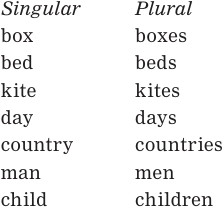
What’s the difference between cat and cats? The noun cat is used when it refers to only one cat; its form is singular. The noun cats is used when it represents more than one cat; its form is plural. Thus, the singular and plural forms tell us about number. Below are some nouns in their singular and plural forms.
Regular and irregular plurals
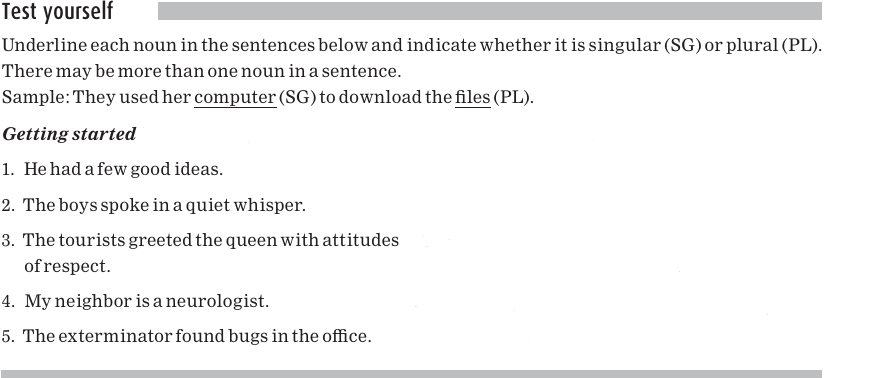
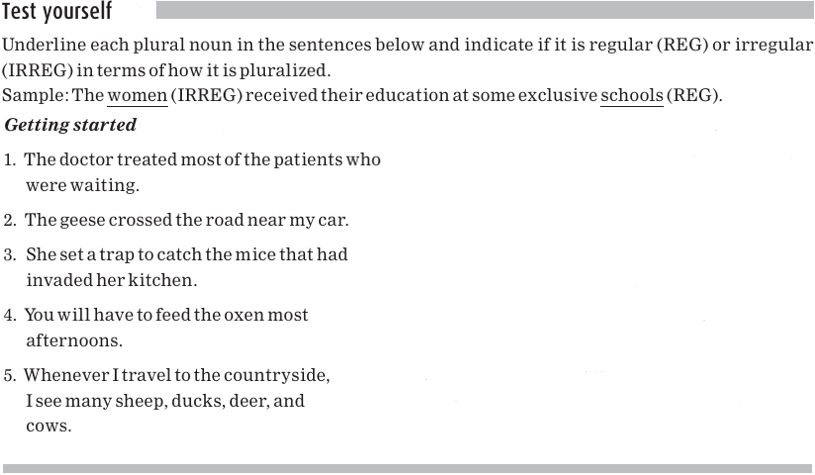
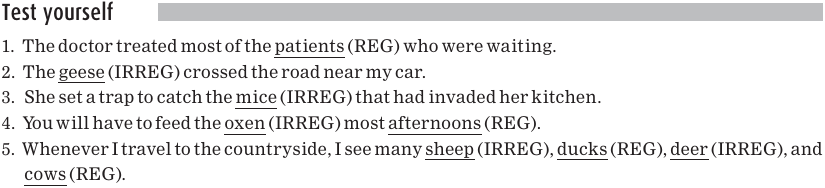
Usually, we pluralize a noun by adding an ‘‘s’’ to it, as in books; these nouns are called regular. There are a handful of nouns that are pluralized in other ways; these nouns are called irregular.
Irregular nouns form their plural in different ways. Here are some common patterns:
1. changing a vowel: man/men, for example
2. adding ‘‘ren’’ or ‘‘en’’: child/children, for example
3. adding nothing: fish/fish, for example
4. changing ‘‘f’’ to ‘‘v’’ and then adding ‘‘s’’: knife/knives, for example
Answers
To enhance your understanding
What is the plural of the ‘‘word’’ blun? Even though you’ve probably never seen this nonsense word, you’re likely to say its plural is bluns. That’s because we don’t have to memorize the ending of regular plurals; we simply use our plural formation rule: ‘‘adds.’’ But the forms for irregular plural words, like children and men, need to be memorized since they don’t follow a consistent pattern.
To further enhance your understanding
Earlier we said that we usually pluralize a noun in English by adding an ‘‘s’’ to it. There’s actually more to it than that, when one examines the pronunciation of regular nouns more closely.
Here are some regular English nouns:
A B
cat dog
lip bee
myth car
laugh deal
Say each word in column A out loud, adding its plural ending. (Don’t whisper, or this won’t work.) You’ll notice that, as you expect, you’re adding an[s] sound to each word.
(Symbols in square brackets [] indicate sounds rather than letters.) Now say each word in column B out loud, adding its plural ending. If you listen carefully, you’ll notice that you’re not adding an [s] sound to each word to make it plural. You’re actually adding a [z]sound! (If English is not your native language, you may not be doing this.)
It turns out that we learned, when we were acquiring English as children, that it is the last sound, and not letter, of a regular noun that determines whether we add [s] or [z]. Some sounds (voiced sounds) are made with our vocal cords vibrating, like the strings of a guitar.
Try this: hold your hand touching your throat, about where a man’s Adam’s apple is, while you say and hold a [v] sound ([v v v v v...]). You’ll feel the vibration of your vocal cords.
Other sounds (voiceless sounds) are made with our vocal cords not vibrating. Now touch your hand to your throat again and this time say and hold an [f]sound ([f f f f f...]); you will notice the lack of vibration.
So how do we know whether to say the plural with an [s] or [z] sound? If the last sound of a word is a voiceless sound, we add an [s] sound to make it plural. If the last sound of a word is a voiced sound, we add a [z] sound to make it plural. This is not a rule that someone has ever taught us, but part of our un conscious knowledge of English.
Notice that having an [s] sound after voiceless sounds makes sense: [s] itself is voiceless. By the same reasoning, having a[z] after voiced sounds also makes sense: [z] itself is voiced. So what you can see is that the last sound of the noun and the sound of the regular plural share the same voicing characteristic: either the vocal cords vibrate for both sounds, or they don’t.
You may have noticed that there’s actually a third type of regular noun. Say the following words out loud, adding the plural ending to each:
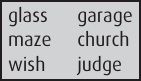
These words all already end in sounds (again, not letters) that are either [s] or [z] or sounds very similar to them. They are all ‘‘noisy’’ sounds. For the plural forms of these words, we add a vowel sound (written with the letter e) followed by a [z] sound (but written with the letter s): glasses, mazes, wishes, garages, churches, judges. If you think about it, pronouncing a vowel between the noisy sound at the end of the noun and the noisy sound [z] of the plural makes sense: without that vowel, we would have two noisy sounds in a row, something that would be harder for the listener to hear clearly.
Wow! You may want to just pause for a moment here and contemplate the complexity of what you know about your language. And you knew how to do this before you even went to kindergarten! You just haven’t known that you know it.








