
Electronic spectra of atoms
 المؤلف:
Peter Atkins, Tina Overton, Jonathan Rourke, Mark Weller, and Fraser Armstrong
المؤلف:
Peter Atkins, Tina Overton, Jonathan Rourke, Mark Weller, and Fraser Armstrong
 المصدر:
Shriver and Atkins Inorganic Chemistry ,5th E
المصدر:
Shriver and Atkins Inorganic Chemistry ,5th E
 الجزء والصفحة:
ص487-488
الجزء والصفحة:
ص487-488
 2025-09-28
 479
479
Electronic spectra of atoms
Key point: Electron-electron repulsions result in multiple absorptions in the electronic spectrum. Figure 20.22 sets the stage for our discussion by showing the electronic absorption spectrum of the d3 complex [Cr (NH3)6]3+ in aqueous solution. The band at lowest energy (longest wavelength) is very weak; later we shall see that it is an example of a ‘spin-forbidden’ transition. Next are two bands with intermediate intensities; these are ‘spin-allowed’ transitions between the t2g and eg orbitals of the complex, which are mainly derived from the
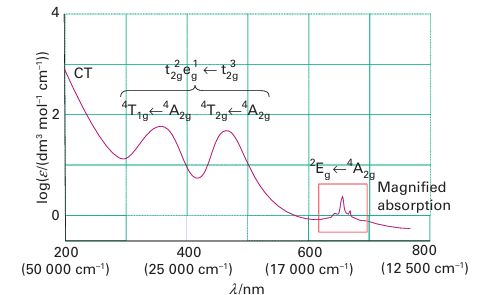
Figure 20.22 The spectrum of the d3complex [Cr (NH3)6]3+, which illustrates the features studied in this section, and the assignments of the transitions as explained in the text.
metal d orbitals. The third feature in the spectrum is an intense charge-transfer band at short wavelength (labelled CT, denoting ‘charge transfer’), of which only the low-energy tail is evident in the illustration. One problem that immediately confronts us is why two absorptions can be ascribed to the apparently single transition t2g2 eg1 ← t2g3. This splitting of a single transition into two bands is in fact an outcome of the electron-electron repulsions mentioned above. To understand how it arises, and to extract the information it contains, we need to consider the spectra of free atoms and ions.
 0
0
 0
0
لا توجد تعليقات بعد
ما رأيك بالمقال : كن أول من يعلق على هذا المحتوى
 الاكثر قراءة في مواضيع عامة في الكيمياء العضوية
 اخر الاخبار
اخبار العتبة العباسية المقدسة








