Reactivity trends
Key points: Fluorine is the most oxidizing halogen; the oxidizing power of the halogens decreases down the group.
Fluorine, F2, is the most reactive nonmetal and is the strong estoxidizing agent among the halogens. The rapidity of many of its reactions with other elements may in part be due to a low kinetic barrier associated with the weak F-F bond. Despite the thermodynamic stability of most metal fluorides, fluorine can be handled in containers made from some metals, such as Ni, because a substantial number of them form a passive metal fluoride surface film on contact with fluorine gas. Fluorocarbon polymers, such as polytetrafluoroethene (PTFE), are also useful
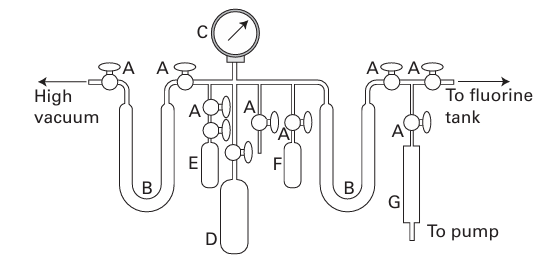
Figure 17.9 A typical metal vacuum system for handling fluorine and reactive fluorides. Nickel tubing is used throughout. (A) Monel valves, (B) nickel U-traps, (C) monel pressure gauge, (D) nickel container, (E) PTFE reaction tube, (F) nickel reaction vessel, and (G) nickel canister filled with soda lime to neutralize HF and react with F2 and fluorine compounds.
materials for the construction of apparatus to contain fluorine and oxidizing fluorine compounds (Fig. 17.9). Few laboratories have the equipment and expertise for research involving elemental F2. The standard potentials for the halogens (Table 17.1) indicate that F2 is a much stronger oxidizing agent than Cl2. The decrease in oxidizing strength continues in more modest steps from Cl2 through Br2 to I2. Although the half-reaction

is favoured by a high electron affinity (which suggests that F should have a lower standard potential than Cl), the process is favoured by the low bond enthalpy of F2 and by the highly exothermic hydration of the small F ion (Fig. 17.10). The net outcome of these three competing effects of size is that F is the most strongly oxidizing element of the group.








