
Intermediate oxidation states in the 4d and 5d series
 المؤلف:
Peter Atkins, Tina Overton, Jonathan Rourke, Mark Weller, and Fraser Armstrong
المؤلف:
Peter Atkins, Tina Overton, Jonathan Rourke, Mark Weller, and Fraser Armstrong
 المصدر:
Shriver and Atkins Inorganic Chemistry ,5th E
المصدر:
Shriver and Atkins Inorganic Chemistry ,5th E
 الجزء والصفحة:
456
الجزء والصفحة:
456
 2025-09-23
 378
378
Intermediate oxidation states in the 4d and 5d series
Key points: Complexes of M(II) with -donor ligands are common for the 3d-series metals but complexes of M(II) of the 4d- and 5d-series metals are less common; they generally contain -acceptor ligands.
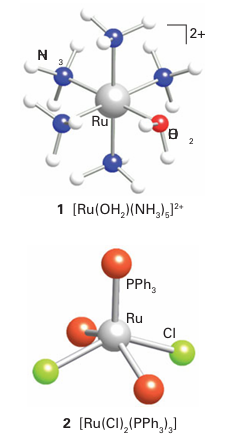
In contrast to the 3d-series, the 4d- and 5d-series metals only rarely form simple M2 (aq) ions. A few examples have been characterized, including [Ru (OH2)6]2+, [Pd (OH2)4]2+, and [Pt (OH2)4]2+. However, the 4d- and 5d-series metals do form many M(II) complexes with ligands other than H2 O; they include the very stable d6 octahedral complexes, such as (1), and the much rarer square-pyramidal d6 complexes, such as (2), which form with bulky ligands. Palladium (II) and platinum (II) form many square-planar d8 complexes, such as [PtCl4]2. The Ru (II) complex in (1) is obtained by reducing RuCl3 .3H2O with zinc in the presence of ammonia; it is a useful starting material for the synthesis of a range of ruthenium (II) pentaamine complexes that have -acceptor ligands, such as CO, as the sixth ligand:

These Ru and the related Os pentaamine species are strong donors, and consequently the complexes they form with the acceptors CO and N2 are stable.
 0
0
 0
0
لا توجد تعليقات بعد
ما رأيك بالمقال : كن أول من يعلق على هذا المحتوى
 الاكثر قراءة في مواضيع عامة في الكيمياء العضوية
 اخر الاخبار
اخبار العتبة العباسية المقدسة








