
Acidic and neutral solvents
 المؤلف:
Peter Atkins, Tina Overton, Jonathan Rourke, Mark Weller, and Fraser Armstrong
المؤلف:
Peter Atkins, Tina Overton, Jonathan Rourke, Mark Weller, and Fraser Armstrong
 المصدر:
Shriver and Atkins Inorganic Chemistry ,5th E
المصدر:
Shriver and Atkins Inorganic Chemistry ,5th E
 الجزء والصفحة:
142
الجزء والصفحة:
142
 2025-08-28
 543
543
Acidic and neutral solvents
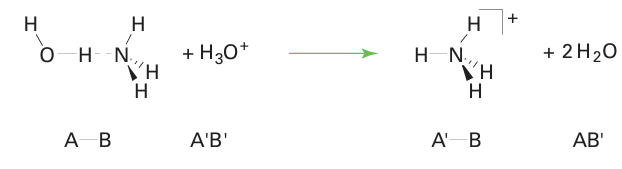
Key points: Hydrogen bond formation is an example of Lewis complex formation; other solvents may also show Lewis acid character. Hydrogen bonding (Section 10.6) can be regarded as an example of complex formation. The ‘reaction’ is between A–H (the Lewis acid) and: B (the Lewis base) and gives the com plex conventionally denoted A–H ... B. Hence, many solutes that form hydrogen bonds with a solvent can be regarded as dissolving because of complex formation. A consequence of this view is that an acidic solvent molecule is displaced when proton transfer occurs:
Liquid sulfur dioxide is a good soft acidic solvent for dissolving the soft base benzene. Unsaturated hydrocarbons may act as acids or bases by using their π or π* orbitals as frontier orbitals. Alkanes with electronegative substituents, such as haloalkanes (for example, CHCl3), are significantly acidic at the hydrogen atom. Saturated fluorocarbon solvents lack Lewis acid and base properties
 0
0
 0
0
لا توجد تعليقات بعد
ما رأيك بالمقال : كن أول من يعلق على هذا المحتوى
 الاكثر قراءة في مواضيع عامة في الكيمياء العضوية
 اخر الاخبار
اخبار العتبة العباسية المقدسة








