Possessive Adjectives
The possessive adjectives are my, your, his, her, its, our, their, and whose. A possessive adjective sits before a noun (or a pronoun) to show who or what owns it.
NB: Since the 1960s, possessive adjectives are increasingly called "possessive determiners." Both terms are still in common use. "Possessive adjective" is currently about twice as popular as "possessive determiner."
Easy Examples of Possessive Adjectives
In the examples below, the possessive adjectives are shaded.
She likes your hat.
(The possessive adjective "your" sits before the noun "hat" to tell us who owns it.)
I think her dog has eaten my gerbil.
(The possessive adjectives "her" and "my" are sitting before (or modifying as it's called) the nouns "dog" and "gerbil" to tell us who owns them.)
Real-Life Examples of Possessive Adjectives
In the examples below, the possessive adjectives are shaded and the nouns being modified are bold. The table also shows how each possessive adjective corresponds to a personal pronoun.
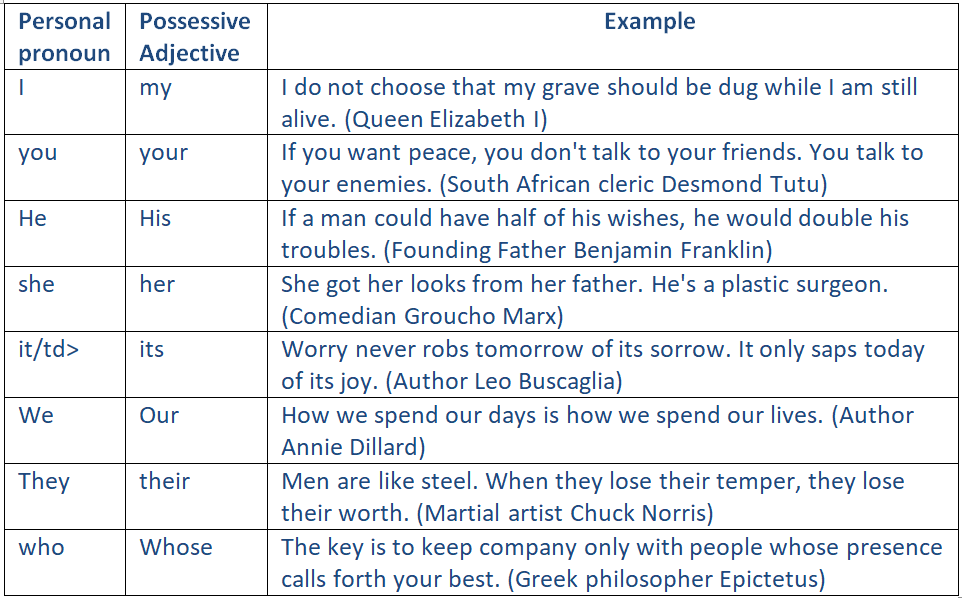
More about Possessive Adjectives
Possessive adjectives are classified as a type of pronoun. Look at this example:
Is that the Queen's hat?
No, it's her crown.(In this example, the possessive adjective "her" replaces the noun "the Queen.")
This example proves that possessive adjectives function like pronouns. (Grammarians say they have "a pronominal function.") As normal adjectives (e.g., big, yellow, funny) don't replace nouns, some grammarians don't classify possessive adjectives as adjectives at all but as determiners.
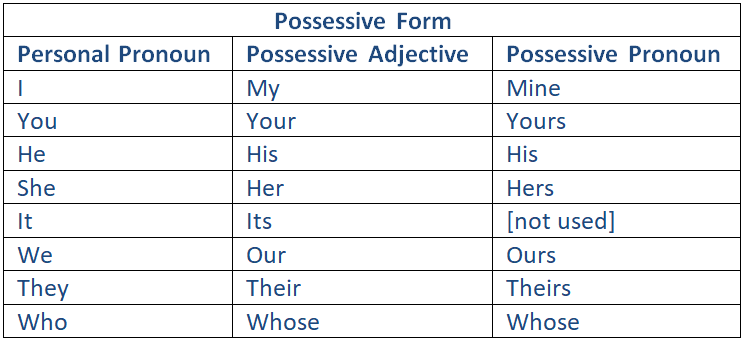
You may find it helpful to group possessive adjectives and possessive pronouns (e.g., mine, yours, hers) under the term possessive form. This helps to differentiate between possessive adjectives (e.g., my, your) and possessive pronouns (e.g., mine, yours).
Here is a list of personal pronouns with their corresponding possessive adjectives and possessive pronouns, i.e., their possessive forms.
Why Should I Care about Possessive Adjectives?
Grammar mistakes with possessive adjectives are rare. However, spelling mistakes with possessive adjectives are common. Given how common the possessive adjectives are, misspelling them (particularly if you make a habit of it) will smash your credibility.
There are four common spelling mistakes with possessive adjectives. (Don't worry. Fixing all four is easy because they're all made the same way – by confusing the possessive adjective with an identical-sounding contraction.)
(Common Mistake 1) Don't write "it's" when you mean "its" (or vice versa)
The contraction "it's" has nothing to do with possession, i.e., it is not a possessive adjective. "It's" is short for "it is" or "it has." This is a 100% rule. If you can't expand your "it's" to "it is" or "it has," then it's wrong.
A country can be judged by the quality of it's proverbs. (incorrect)
To some extent, this mistake is understandable because apostrophes are used for possession (e.g., the dog's nose). But, "it's" has nothing to do with possession. No, really, it doesn't.
(Common Mistake 2) Don't write "you're" when you mean "your" (or vice versa).
"You're" is short for "you are." This is a 100% rule. If you can't expand your "you're" to "you are," then it's wrong.
Even if you fall on you're face, you're still moving forward. (incorrect)
(The first "you're" is wrong. The second is correct.)
(Common Mistake 3) Don't confuse "there," "they're", and "their."
"They're" is short for "they are." This is a 100% rule. If you can't expand your "they're" to "there are," then it's wrong. "There (just like the word "here") is a place. It's also used in expressions like "There are dragons" or "There's an issue."
Forgive your enemies, but never forget there names. (incorrect)
(Common Mistake 4) Don't write "who's" when you mean "whose" (or vice versa).
"Who's" is short for "who is" or "who has." This is a 100% rule. If you can't expand your "who's to "who is" or "who has," then it's wrong.
Never go to a doctor who's office plants have died. (incorrect)
(A More Technical Issue) Don't use "his/her."
There's an issue with possessive adjectives in English. We don't have a singular non-gender-specific one that can be used with people. We have "its," but you can't use "its" with people.
Each owner is responsible for its dog. (incorrect)
("Its" can't be used with people.)
So, when your singular person could be male or female, you have two options: (1) use "their" or (2) use "his/her."
Each owner is responsible for their dog. (correct)
(Using "their" to replace a singular noun (here, "owner") is acceptable. This is the best option.)
Each owner is responsible for his/her dog. (incorrect)
(This is acceptable to some, but it's clumsy.)
There used to be a third option: use "his" with a caveat.
Each owner is responsible for his dog. (incorrect)
(This is acceptable if all owners are male. If they're not, avoid this option, even with a caveat explaining that "his" means "his/her.")








