
Line Integral
 المؤلف:
Krantz, S. G.
المؤلف:
Krantz, S. G.
 المصدر:
"The Complex Line Integral." §2.1.6 in Handbook of Complex Variables. Boston, MA: Birkhäuser
المصدر:
"The Complex Line Integral." §2.1.6 in Handbook of Complex Variables. Boston, MA: Birkhäuser
 الجزء والصفحة:
...
الجزء والصفحة:
...
 21-8-2018
 2598
2598
Line Integral
The line integral of a vector field  on a curve
  is defined by
 |
(1)
|
where  denotes a dot product. In Cartesian coordinates, the line integral can be written
 |
(2)
|
where
![F=[F_1(x); F_2(x); F_3(x)].](http://mathworld.wolfram.com/images/equations/LineIntegral/NumberedEquation3.gif) |
(3)
|
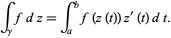
For  complex and
  a path in the complex plane parameterized by
 ![t in [a,b]](http://mathworld.wolfram.com/images/equations/LineIntegral/Inline6.gif) ,
,
 |
(4)
|
Poincaré's theorem states that if  in a simply connected neighborhood
  of a point
  , then in this neighborhood,
  is the gradient of a scalar field
  ,
,
 |
(5)
|
for  , where
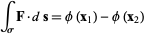
  is the gradient operator. Consequently, the gradient theorem gives
 |
(6)
|
for any path  located completely within
  , starting at
  and ending at
  .
.
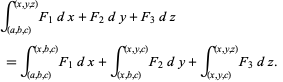
This means that if  (i.e.,
  is an irrotational field in some region), then the line integral is path-independent in this region. If desired, a Cartesian path can therefore be chosen between starting and ending point to give
 |
(7)
|
If  (i.e.,
  is a divergenceless field, a.k.a. solenoidal field), then there exists a vector field
  such that
 |
(8)
|
where  is uniquely determined up to a gradient field (and which can be chosen so that
  ).
).
REFERENCES:
Krantz, S. G. "The Complex Line Integral." §2.1.6 in Handbook of Complex Variables. Boston, MA: Birkhäuser, p. 22, 1999.
 الاكثر قراءة في التفاضل و التكامل
 اخر الاخبار
اخبار العتبة العباسية المقدسة









