الوضع الليلي


 1:49:34
  2026-04-26
  1413
1413
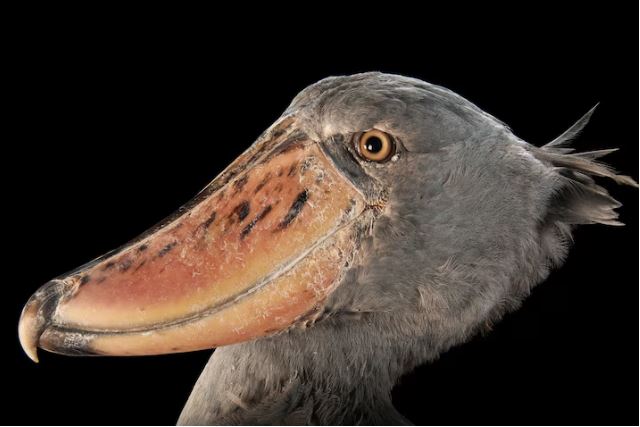
The shoebill (Balaeniceps rex) is a striking and unusual bird, easily recognized by its massive, shoe-shaped bill. This bill—about a foot long, five inches wide, and ending in a sharp hook—is its most distinctive feature and a powerful hunting tool. It allows the shoebill to catch large prey such as lungfish, tilapia, eels, snakes, and even small crocodiles and monitor lizards.
Physically, the shoebill looks almost prehistoric. It can grow up to five feet tall with an eight-foot wingspan, and it has gray feathers, a white belly, yellow eyes, and a small crest on its head. Its long legs and wide feet help it move carefully across swamp vegetation in the freshwater marshes of East Africa, where it lives.
Despite its size, the shoebill is a patient ambush predator. It can stand completely still for hours, waiting for prey to come close. When the moment arrives, it uses a sudden movement known as “collapsing,” lunging forward to seize its target.
Taxonomically, the shoebill is unique—it belongs to its own family. Although it shares traits with storks and herons, such as long legs and neck, its closest relatives are actually pelicans.
Shoebills are generally quiet birds, but they sometimes communicate through bill-clattering, especially during greeting or nesting. They also use “gular fluttering,” vibrating their throat muscles, to stay cool in hot environments.
In terms of reproduction, shoebills are monogamous and reach maturity at around three to four years. They build large nests—sometimes up to eight feet wide—on water or floating vegetation. Females typically lay two eggs, and both parents care for them by incubating, turning, and cooling them with water carried in their bills. However, usually only one chick survives to maturity.
Unfortunately, shoebills are vulnerable to extinction. With only about 3,300 to 5,300 adults remaining, their population is declining. Habitat loss from agriculture, pollution, and human activity, along with hunting, poses serious threats to their survival.
Reality Of Islam |
|

Plants are

After spend

A study of

Researchers
 9:3:43
2018-11-05
9:3:43
2018-11-05
10 benefits of Marriage in Islam
7:5:22
2019-04-08
benefits of reciting surat yunus, hud &
9:45:7
2018-12-24
advantages & disadvantages of divorce
11:35:12
2018-06-10
6:0:51
2018-10-16
4:25:57
2023-02-11
8:3:0
2018-06-21
8:15:37
2023-02-16
9:30:2
2021-11-12
3:18:29
2022-12-24
5:58:12
2021-12-18
9:42:16
2022-10-19
5:41:46
2023-03-18
| LATEST |
 HOME
HOME