الوضع الليلي


 11:27:45
  2026-04-07
  1576
1576
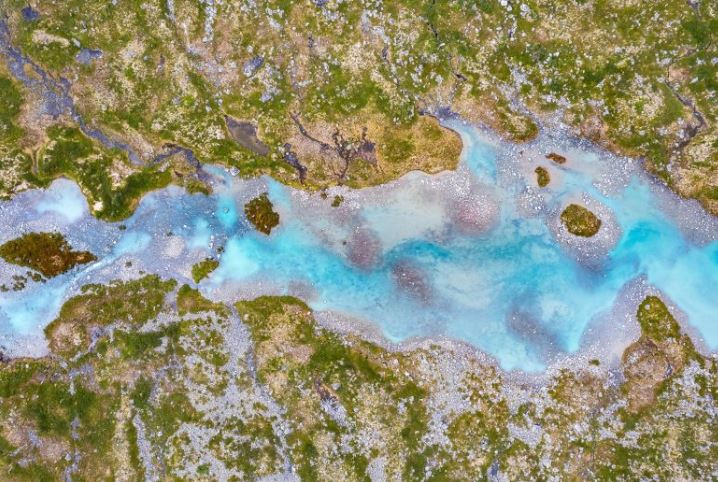
Thawing Arctic ground is unleashing ancient carbon—and speeding up climate change.
Scientists have taken a detailed new look at what happens when Arctic permafrost begins to thaw, revealing major changes to water flow and carbon movement across northern Alaska. The research, led by geoscientist Michael Rawlins at the University of Massachusetts Amherst, provides one of the most precise views yet of how this rapidly warming region is evolving.
The team focused on a region of Alaska’s North Slope about the size of Wisconsin, where hundreds of rivers and streams drain into the Beaufort Sea. Using 44 years of model data at a fine one-kilometer resolution, they found that runoff is increasing significantly, more previously frozen carbon is entering rivers, and the thawing season now stretches later into the year, reaching late summer and fall. These findings were recently published in Global Biogeochemical Cycles.
Why Arctic Rivers Matter for the Global Climate
Arctic rivers play an outsized role in Earth’s systems. They carry about 11% of the world’s river water into an ocean that holds only 1% of global ocean volume. This makes the Arctic Ocean highly sensitive to changes happening upstream.
While snowmelt is a major contributor to river flow, thawing permafrost is becoming increasingly important. Beneath the surface lies a layer of soil that freezes and thaws each year, known as the “active layer.” As temperatures rise, this layer is getting deeper, allowing more groundwater to feed into rivers.
Ancient Carbon Is Entering Arctic Waters
The deepening active layer contains large amounts of organic carbon that have been frozen for thousands of years. As the soil thaws, more of this material is released into rivers as dissolved organic carbon (DOC), eventually reaching the ocean.
The Arctic Ocean already receives a disproportionate share of this carbon compared to other regions. Each year, more than 275 million tons of it are converted into carbon dioxide, contributing to additional warming and creating a feedback loop that can further accelerate climate change.
Modeling Arctic Rivers at Unprecedented Detail
Understanding how individual rivers respond to warming has been difficult due to limited direct measurements in northern Alaska.
“What makes this question so hard to answer is that direct observations are very sparse in northern Alaska,” says Rawlins, extension associate professor of Earth, Geographic, and Climate Sciences at UMass Amherst. “There are nowhere near enough river sample measurements to quantify inputs to estuaries along the entire Alaskan North Slope.”
To overcome this, Rawlins and his team relied on a sophisticated model developed over 25 years. Known as the Permafrost Water Balance Model, it simulates snow, soil, water flow, and changes in the active layer to estimate real-world conditions. The model was expanded in 2021 to include dissolved organic carbon, and later applied across 22.45 million square kilometers of Arctic land.
Previous results suggest that over the next 80 years, the Arctic could see up to 25% more total runoff, 30% more subsurface flow, and increasing dryness in southern regions.
A New Level of Precision in Arctic Research
Earlier versions of the model used 25-kilometer grid cells, but this study achieved much greater detail.
“We’ve typically run the model on 25-kilometer grid cells,” says Rawlins. “This new study is the first time anyone has captured such a wide area of the Arctic—about the size of Wisconsin—down to the kilometer scale, and over such a long period of time: our model simulates daily river flows and coastal exports over 44 years from 1980 to 2023.”
Running the simulations required significant computing power. Each model run took 10 continuous days on a supercomputer at the Massachusetts Green High Performance Computing Center.
“Our freshwater and DOC inputs to coastal estuaries will be useful to a broad range of stakeholders interested in these unique ecosystems in coastal northern Alaska,” says Rawlins, “including the Beaufort Lagoon Ecosystems project, which is helping to quantify exactly what’s coming through these coastal estuaries.”
Where Carbon Release Is Increasing the Most
The study shows that while thawing and runoff are rising across the region, the largest increases in carbon export are occurring in northwest Alaska.
“It’s flatter over there,” says Rawlins, “which means there’s much more carbon from decaying matter in the permafrost that has been accumulating for tens of thousands of years. This is ancient carbon. The further east you go, the more mountainous it becomes. The soil is rockier and sandier, and so far less DOC is mobilized as the permafrost thaws.”
A Longer Thaw Season Is Driving Change
One of the most unexpected findings is how much of the change is being driven directly by permafrost thaw. The thaw season itself is now lasting longer, extending into September and even October, several weeks beyond what was typical in the past.
These shifts are likely affecting salinity, nutrient cycles, and food webs in the Beaufort Sea. Researchers are now examining how features known as ice wedge polygons, common across the Arctic, influence the movement of water and carbon toward coastal areas.
A Critical Gap in Climate Understanding
“How much DOC finds its way to the ocean via rivers and streams is a part of the carbon cycle we don’t know much about,” says Rawlins. “We desperately need more of these land-to-ocean connection studies if we’re to fully grapple with the problem of global warming and the effects it will have on coastal ecosystems.”
Reality Of Islam |
|
Plants are
After spend
A study of
Researchers
 9:3:43
2018-11-05
9:3:43
2018-11-05
10 benefits of Marriage in Islam
7:5:22
2019-04-08
benefits of reciting surat yunus, hud &
9:45:7
2018-12-24
advantages & disadvantages of divorce
11:35:12
2018-06-10
6:0:51
2018-10-16
10:35:40
2022-05-26
9:39:36
2022-12-28
10:43:56
2022-06-22
6:0:8
2023-03-19
4:25:57
2023-02-11
10:55:53
2022-06-13
7:45:39
2018-06-21
5:41:46
2023-03-18
| LATEST |
 HOME
HOME