الوضع الليلي


 1:22:37
  2025-09-25
  2135
2135
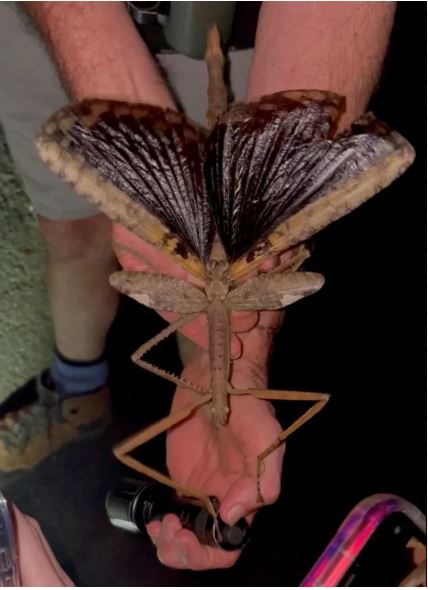
A thousand meters up in a humid, cloud-covered forest, amidst a slew of twigs and limbs, an onlooker spotted something different—this branch had legs. But even for a stick insect, a forest dweller evolved to look like a tree offshoot, this one was unusual. They quickly snapped a picture and posted it to social media. That’s how scientists first saw the creature, which is now recognized as a newly discovered species and the heaviest known insect in Australia.
“We didn’t expect to find anything this big,” says Angus Emmott, a researcher at James Cook University in Australia who helped identify the insect. “It’s about the length of your forearm.”
The largest collected example of the species, now called Acrophylla alta, weighed in at 44 grams—about the weight of a golf ball. It’s a third heavier than Australia’s previous heavyweight champ, Emmott says, and is just a few inches smaller than the country’s longest insect. “This one definitely blends in better as a branch than a twig” says Nicole Gunter, the curator of entomology at Queensland Museum, home to two Acrophylla alta specimens.
New insect species are frequently discovered, and while nearly two million have been identified, there may be as many as 30 million unidentified insect species left in the world. Gunter’s own museum collection receives newly identified insects multiple times throughout the year, but it's still uncommon to find one this large.
“[This species] is predicted to be living high up in the rainforest canopies, and it was only by chance that one of them blew down that we were able to find it,” Gunter says. “Given that there have only been a small number of these specimens collected, it's quite possible that there are even larger … that haven't been found yet.”
Australia is no stranger to big animals, and its more humid, lush regions create the perfect habitat for larger insects like the Acrophylla alta to thrive. Still, the title for heaviest insect ever recorded goes to a giant wētā found in nearby New Zealand. The cricket-like critter weighed in at 71 grams, a remarkable weight even for a species known for its colossal size. But more monster insects might be out there—in the region and beyond.
“There's a lot of assumption that sometimes the biggest species might already be described,” Gunter says. “So of course, it's exciting to see that something this large could have been unknown within the scientific literature to date, and it gives us a better understanding of our biodiversity and what's still out there.”
Reality Of Islam |
|
Plants are

After spend

A study of

Researchers
 9:3:43
2018-11-05
9:3:43
2018-11-05
10 benefits of Marriage in Islam
7:5:22
2019-04-08
benefits of reciting surat yunus, hud &
9:45:7
2018-12-24
advantages & disadvantages of divorce
11:35:12
2018-06-10
6:0:51
2018-10-16
6:0:8
2023-03-19
11:11:59
2023-02-01
12:10:56
2022-11-17
3:43:50
2022-11-05
10:47:11
2022-11-22
3:18:29
2022-12-24
9:42:16
2022-10-19
5:41:46
2023-03-18
| LATEST |
 HOME
HOME