الوضع الليلي


 3:53:43
  2024-09-02
  1645
1645
Just outside the Milky Way Galaxy, roughly 210,000 light-years from Earth, there is the dwarf galaxy known as the Small Magellanic Cloud (SMC). Measuring about 18,900 light-years in diameter and containing roughly 3 billion stars, the SMC and its counterpart – the Large Magellanic Cloud (LMC) – orbit the Milky Way as satellite galaxies.
Scientists are particularly interested in these satellites because of what they can teach us about star formation and the process where galaxies evolve through mergers, which is something the Milky Way will do with these two galaxies someday.
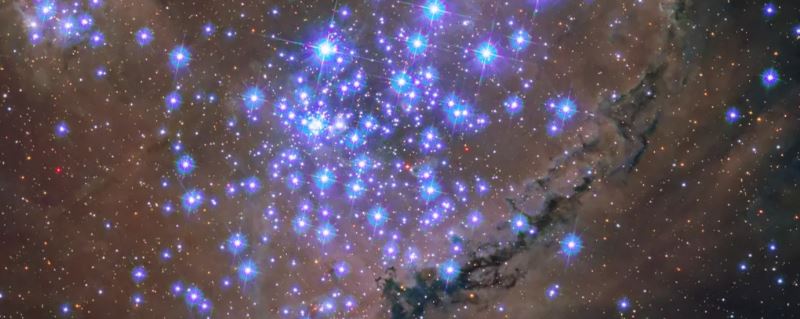
Another interesting feature of the SMC is the spectacular star cluster known as NGC 346, located near the center of the brightest star-forming region in the SMC, the hydrogen-rich nebula designated N66.
Yesterday, NASA released a new image of this star cluster acquired by the venerable Hubble Space Telescope, which provides a unique and breathtaking view of this star cluster.
The interaction between the dozens of hot, young, blue stars and the surrounding dust and gas makes this region one of the most dynamic and intricately detailed star-forming clusters ever observed.
While NGC 346 has been observed by Hubble in the past and more recently by the James Webb Telescope, the images they took combined visible and infrared light, showcasing the gas and dust structure of the surrounding nebula. This latest view combined ultraviolet and some visible light data from Hubble's Advanced Camera for Surveys (ACS) and Wide Field Camera 3 (WFC3).
The purpose of these observations is to learn more about star formation and how it shapes the interstellar medium (ISM) of low-metallicity galaxies like the SMC. These conditions are believed to be similar to what existed during the early Universe when there were very few heavy elements.
It was not until the first generation of stars (Population III) and galaxies emerged – that heavier elements began to form. These were distributed throughout space when these stars reached the end of their relatively short life cycle and went supernova.
After more than three decades of service, the Hubble Space Telescope is still fulfilling its original purpose: helping scientists investigate the origins and evolution of the Universe!
Reality Of Islam |
|
A study of
Researchers
MIT enginee
 9:3:43
2018-11-05
9:3:43
2018-11-05
10 benefits of Marriage in Islam
7:5:22
2019-04-08
benefits of reciting surat yunus, hud &
9:45:7
2018-12-24
advantages & disadvantages of divorce
11:35:12
2018-06-10
6:0:51
2018-10-16
8:39:51
2022-09-23
2:42:26
2023-02-02
6:28:21
2022-12-20
the happy life of mankind requirement
6:36:36
2022-01-25
8:3:0
2018-06-21
9:30:2
2021-11-12
11:11:59
2023-02-01
5:41:46
2023-03-18
| LATEST |
 HOME
HOME