
الوضع الليلي


 9:35:51
  2024-04-04
  2735
2735
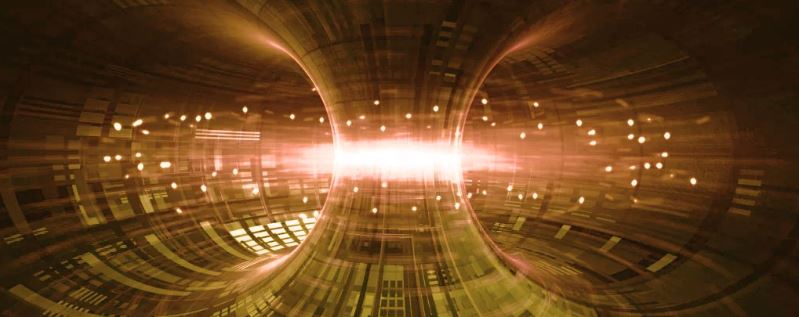
Upgrades to Korea's 'artificial Sun' fusion reactor have produced another record-breaking result, with new components able to better withstand blistering temperatures and sustain a swirling ball of 100 million-degree plasma for almost 50 seconds.
It's a leap of close to 20 seconds from the Korea Superconducting Tokamak Advanced Research reactor (KSTAR), which has been smashing its own records in recent years for how long it can generate and contain insanely hot plasma in its donut-shaped hull.
At 100 million degrees Celsius, heavy hydrogen isotopes in the plasma (a hot cloud of ionized gas) are forced to fuse together, releasing energy in a fashion that's similar to what's happening in the sun's core. However, the challenge for nuclear fusion – which promises cleaner, near-limitless energy – is to contain this writhing loop of plasma using magnetic fields.
KSTAR's latest result is impressive because it confronts some key challenges in the road to fusion power, although other fusion reactors in the same class of technology have pushed the limits further.
By test-driving the new components, KSTAR is paving the way for the International Thermonuclear Experimental Reactor (ITER) – which could be the world's largest tokamak fusion reactor if it can overcome budget blow-outs and technical hurdles.
KSTAR's new record – announced by the Korea Institute of Fusion Energy (KFE) last week – stems from upgrades made in 2023 to the reactor's divertor, a component that handles the hottest temperatures inside the reactor while funneling waste products away.
KSTAR's divertor is now made of tungsten, which has a very high melting point but doesn't absorb the plasma fuel like a sponge or react with it the way the previous carbon-based divertors would.
Installation of the new divertors was completed last year, helping to extend KSTAR's record fusion time to 48 seconds in its latest 3-month run, up from half a minute in 2021.
"Despite being the first experiment run in the environment of the new tungsten divertors, thorough hardware testing and campaign preparation enabled us to achieve results surpassing those of previous KSTAR records in a short period," Si-Woo Yoon, director of the KSTAR Research Center, explained in a statement.
However, the divertor's performance at temperatures seven times that of the sun had to be proven; it was by no means a sure thing.
The KFE researchers expected it to perform much like a carbon-based divertor, but there was a risk the tungsten could shatter or that the new set-up would fail to generate plasma. Not only had the material of the divertor changed, but also its shape.
"At the beginning of the campaign, the temperature of the inner wall of the tokamak did not rise well," says KFE physicist Hyunseok Kim, but the researchers were able to quickly adjust to the new operating conditions to wrangle the plasma with magnetic fields.
The tungsten divertor wasn't the onlu upgrade helping to improve KSTAR's performance, either. KFE researchers, collaborating with the US Department of Energy's Princeton Plasma Physics Laboratory and writing in Nature Communications in February, described how they found a way to stabilize weaknesses at the edge of the plasma caused by minuscule defects in the magnetic coils that hold the plasma in place.
The improvement led to a second milestone – containing plasma in a highly-efficient state called a high-confinement or 'H-mode' for 102 seconds. Previous attempts were limited to a few seconds before performance dipped dramatically.
Ideally, a fully operational fusion power station would operate at critical temperatures in H-mode for periods long enough to generate a sustainable source of energy. These achievements represent a monumental step towards this goal.
Hyeon-seon Han, a plasma physicist in KFE's High-Performance Scenario Research Team, says the team are currently reviewing this latest batch of experimental data, which will feed into ITER's preparations, assembling their results for publication, and planning their next campaign.
Han hopes that soon they can break through the 50-second mark on their way to the project's ultimate goal of achieving 300 seconds of plasma operation with temperatures over 100 million degrees by the end of 2026.
That's six times longer than KSTAR's current record, and still minutes shorter than China's Experimental Advanced Superconducting Tokamak (EAST) reactor, which as of April last year, could generate and sustain plasma for almost seven minutes.
But it takes massive amounts of energy to power up fusion reactors and generate plasma reactions for even a few seconds – so their ability to generate plentiful clean energy is still several decades away.
Reality Of Islam |
|

A study of

Researchers

MIT enginee
 9:3:43
2018-11-05
9:3:43
2018-11-05
10 benefits of Marriage in Islam
7:5:22
2019-04-08
benefits of reciting surat yunus, hud &
9:45:7
2018-12-24
advantages & disadvantages of divorce
11:35:12
2018-06-10
6:0:51
2018-10-16
9:50:37
2023-02-28
5:58:12
2021-12-18
6:0:8
2023-03-19
2:33:4
2023-02-15
7:0:55
2022-05-17
7:59:14
2018-06-21
8:3:0
2018-06-21
5:41:46
2023-03-18
| LATEST |
 HOME
HOME























