
الوضع الليلي


 3:52:33
  2023-09-30
  1930
1930
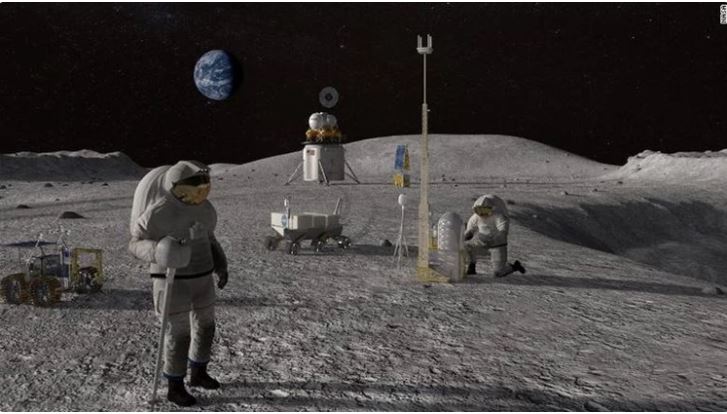
At the moon's South Pole, there is an area located between two craters where there is a large amount of water and constant sunlight, which may provide a good environment for humans to live in.
Antarctica has long been considered a good place for settlement because its many craters are exposed to constant sunlight and shade, making it possible to generate electricity using solar panels, while also having ice to extract water.
A never-before-seen image of the Moon's South Pole shows candidate landing sites for NASA astronauts
The areas surrounding some of these craters have been explored by lunar rovers, such as India's recent Chandrayaan-3 mission, but their goal was to collect scientific data rather than to search for a primary location.
Five holes were being considered due to their constant sunlight, but the amount of water and other resources must be taken into consideration before determining the location.
Scientists at the University of Atacama in Chile examined data on the five potential craters to determine which would be the best, according to New Scientist.
The five craters are called De Gerlach, Henson, Sverdrup, and Shackleton, and one of them is an unnamed crater.
The scientists took into account the distribution of water ice, slope angles, and the amount of sunlight available to each hole, along with the density of carbon dioxide in the frozen water, other potential energy sources, ease of access, and communication links with Earth.
For his part, team leader Giovanni Leone told New Scientist magazine that an area of about 5 square kilometers extending over two craters, collectively known as Sverdrup-Henson, is the best possible place to establish the first base.
This area has a relatively flat surface, which makes construction and transportation easier, in addition to the presence of more ice and minerals in the shaded areas nearby. There are also areas exposed to permanent sunlight, for power generation, and locations for communication links to the ground.
“It's a trade-off between the water on hand and, at the same time, the base has to be illuminated to get some energy,” Leon noted.
One of the unique factors about the Sverdrup-Henson site is its ease of access, compared to other craters with high ledges. “There is potential for expansion everywhere, since there is direct access in and out of the Sverdrup-Henson craters,” Leon says.
Reality Of Islam |
|

A study of

Researchers

MIT enginee
 9:3:43
2018-11-05
9:3:43
2018-11-05
10 benefits of Marriage in Islam
7:5:22
2019-04-08
benefits of reciting surat yunus, hud &
9:45:7
2018-12-24
advantages & disadvantages of divorce
11:35:12
2018-06-10
6:0:51
2018-10-16
8:3:0
2018-06-21
6:14:3
2023-01-18
7:34:7
2023-02-28
2:42:26
2023-02-02
8:19:41
2018-06-21
al-hussain (peace be upon him)
10:18:1
2022-09-21
allah will not answer all your prayers
6:56:28
2022-01-01
5:41:46
2023-03-18
| LATEST |
 HOME
HOME























