constituent (n.)
A basic term in GRAMMATICAL analysis for a LINGUISTIC UNIT which is a functional component of a larger CONSTRUCTION. In an alternative formulation, a constituent is a set of NODES exhaustively DOMINATED by a single node. Based on a combination of intuitive and FORMAL (e.g. DISTRIBUTIONAL) criteria, a SENTENCE can be analyzed into a series of constituents, such as SUBJECT + PREDICATE, or NP+VP, etc. These units thus produced can, in turn, be analyzed into further constituents (e.g. a NOUN PHRASE might consist of a DETERMINER and a noun), and this constituent analysis process can be continued until no further subdivisions are possible. The major divisions that can be made within a construction, at any level, are known as the immediate constituents (ICs) of that construction. The irreducible ELEMENTS resulting from such an analysis are known as the ultimate constituents (UCs) of the construction. So, in analyzing the sentence The clock has stopped, the ICs would be the clock and has stopped (how these constituents are to be LABELLED is a separate decision-making process). the clock has the and clock as its ICs. The ICs of has stopped are has and stopped. And stopped can be broken down further into stop and -ed. The process is often drawn in the form of a TREE diagram, as follows:
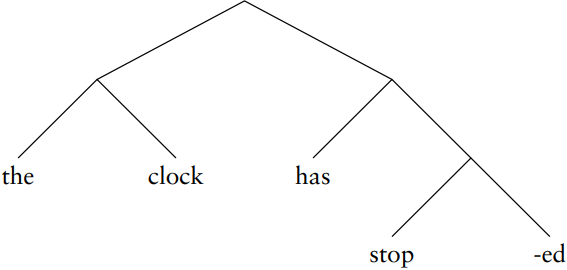
This constituent structure may also be represented using BRACKETS, each analytic decision being represented by the imposition of a pair of square brackets at the appropriate points in the construction, e.g. [[the clock] [has stop[-ed]]]. A grammar which analyses sentences wholly in this way, i.e. in terms of a HIERARCHY of structural layers, is sometimes called a constituent-structure grammar; in classical GENERATIVE linguistics, such an analysis is carried on by the PHRASE-STRUCTURE COMPONENT of the grammar. The term constituency grammar will also be encountered, as will the term constituent sentence, referring to an EMBEDDED sentence. Constituent-base grammars need to be distinguished from those which do not recognize constituents, such as DEPENDENCY grammar and WORD GRAMMAR.
The limitations of IC analysis have been much discussed in the linguistics literature, especially in relation to the greater POWER of TRANSFORMATIONAL grammars. IC analysis, for example, is unable to make explicit the relationships between formally connected sets of sentences (such as ACTIVE and PASSIVE), nor can it demonstrate the AMBIGUITY involved in several kinds of construction (a much-discussed example here being it is too hot to eat). But some kind of constituent analysis is an important feature of most grammatical systems.
In NON-LINEAR PHONOLOGY, a term which describes a group of FEATURES which regularly FUNCTION together as a UNIT in phonological RULES. In this approach, SEGMENTS are REPRESENTED as a HIERARCHY of NODE configurations, in which intermediate nodes are constituents and terminal nodes are feature values. Elements are grouped into constituents using ASSOCIATION LINES. Only feature sets which form constituents may function together in phonological rules. The approach uses the usual TREE terminology of GENERATIVE grammar: dependents are viewed as ‘daughters’ of a higher constituent node, and ‘sisters’ of other nodes at the same level within the hierarchy.








