Gas pressure and flow control
For accurate and reproducible gas chromatography, either a constant carrier-gas flow or a constant carrier-gas pressure must be maintained. Under isothermal conditions, simple pressure control is adequate for packed or capillary columns and back pressure can be monitored by a pressure gauge between the flow controller and the injector. A decrease indicates a leaking septum and an increase suggests contamination of the injector liner or the top of the column. Flow control is highly desirable, if not essential, during temperature programming with packed columns and can be used to advantage with capillary columns. The added convenience of a digital (electronic) flow controller may be worthwhile.
Since the carrier gas becomes more viscous in the column as the temperature rises, the gas pressure must be increased as the run progresses to maintain constant velocity (or constant flow)
throughout the analysis. Figure 1 shows the effects of increasing the column temperature on the carrier gas flow and velocity if the head pressure is held constant during the run. As flow and velocity do not respond identically to increasing temperature (see Fig. 1D), late-eluting analytes are recovered more quickly using constant flow than under constant pressure conditions. Furthermore, since column efficiency is a function of the carrier gas velocity (Fig. 18.12), resolution at the end of the chromatogram is improved under constant flowc conditions. Switching between conditions of either constant flow or constant pressure can sometimes resolve otherwise co-eluting compounds.
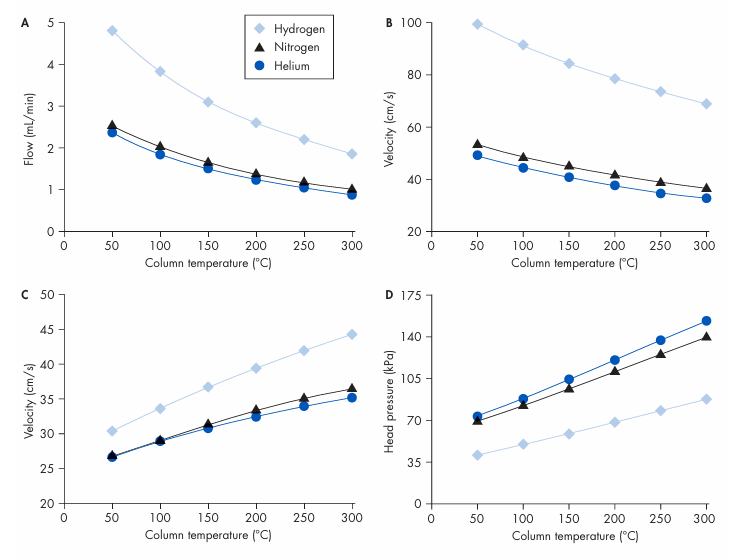
Figure 1 Effect of temperature on carrier-gas flow and velocity. (A) and (B) are under conditions of constant carrier gas head pressure (140kPa). (A) shows the change in column flow (mL/min) with change in temperature from 50 to 300°C. (B) shows the change in velocity (cm/s) with change in temperature from 50 to 300°C. (C) and (D) are under conditions of constant carrier-gas flow (1mL/min). (C) shows the change in carrier-gas velocity (cm/s) with change in temperature from 50 to 300°C. (D) shows the change in column head pressure (kPa) with change in temperature from 50 to 300°C. All calculations are for a 25m column of 0.25mm i.d. operating at atmospheric pressure.
The way in which carrier-gas velocity affects column efficiency is best demonstrated by refer ence to the van Deemter curves in Figure 2. These demonstrate that the optimum column efficiency (minimum plate height, H) occurs at intermediate velocity, and that column efficiency is compromised at both low and very high velocity. A small loss in efficiency for a shorter analysis time is usually tolerated. Curves are shown for the three most common carrier gases (helium, nitrogen and hydrogen). Of the three gases, nitrogen produces the highest efficiency (smallest value for height equivalent of a theoretical plate; HETP) but it can be seen that the chromatography is much less tolerant to changes in nitrogen velocity than to helium. Helium is favoured by most users, as analysis times are half that with nitrogen, with only a slight loss in efficiency. Although hydrogen gives the best dynamic range and shortest analysis times, there are safety issues relating to its use. While the gas used for the carrier gas should always be of the highest purity available, a lower quality gas can sometimes be used for the makeup or detector, since these do not contribute to column deterioration by oxidation.
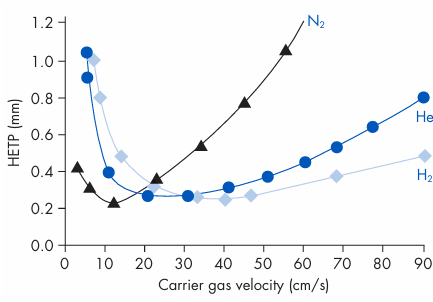
Figure 2 Van Deemter plots for a 25 m x 0.25 mm i.d. WCOT OV-101 column (HETP, height equivalent of a theoretical plate).
Regardless of quality, it is advisable always to use a scrubber (to remove oxygen and hydrocarbons) followed by a dryer (to remove water vapour) between the supply and the instrument. Metal trap bodies are recommended, as plastics are permeable to impurities in laboratory air, especially when large amounts of organic solvents are used. Most traps have an indicator to show when they are saturated, and they can be changed without interruption to the gas flow. Stainless steel or copper tubing is recommended for plumbing of all gases, as plastics are permeable to moisture and oxygen, and Teflon, nylon, polyethylene, polypropylene and PVC contain contaminants that degrade gas purity.








