Cognitive approaches to grammar
Blending Theory
Discussion
One of the major contributions of Blending Theory is to have successfully shown that the meaning of any complex expression is not the sum of the meanings of its parts. Its constitutive elements are better regarded as prompts for the construction of the overall meaning. More often than not, new structure emerges from the fusion of two (or more) elements which was not present in either.1
Further, it should be pointed out that the analysis of specific cases like the resultative and caused motion constructions provided by Blending Theory is superior to approaches like Goldberg’s and Langacker’s. Fauconnier and Turner’s analysis implies that we should distinguish between two event levels when dealing with sentences like I boiled the pan dry and He sneezed the napkin off the table.
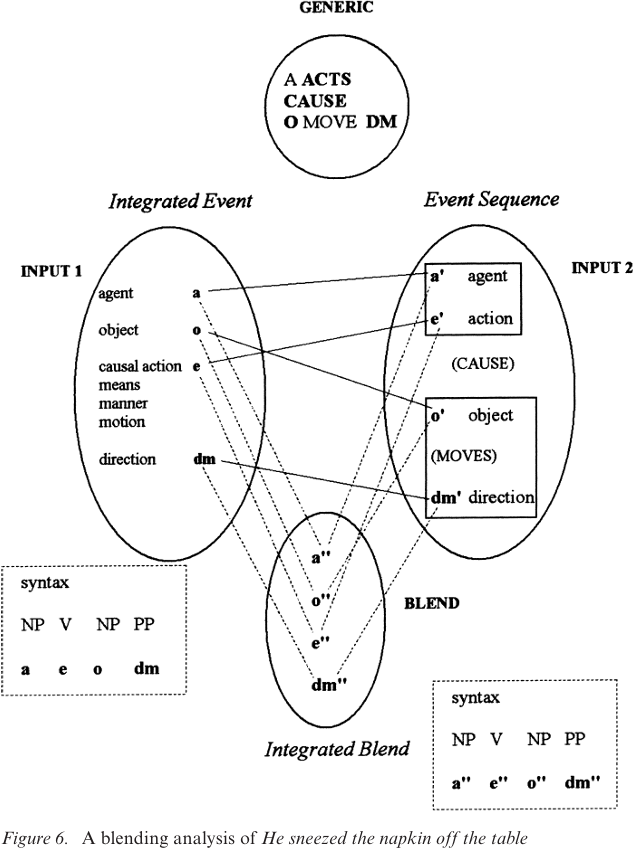
The former sentence does not mean literally that I performed any action on the pan (I could have forgotten about the pan and let the water in it evaporate). However, in the blend we construe the real-world event sequence in terms of the subject’s acting on the pan itself. It is not simply a matter of the construction’s imposing a causal interpretation on the specific verb being used (as Goldberg claims) or of categorizing the event referred to by the verb as a force-dynamic event (as Langacker claims, see also Broccias 2003). We also construe the whole unintegrated event sequence as a very compact event, where results are construed as obtaining immediately because some force-dynamic action is being carried out on a manipulable entity.
There is, however, a potential problem with Fauconnier and Turner’s approach (see Broccias 2003: Ch.5 and Broccias 2004). It is not clear why the parts in the event sequence represented as input 2 in Figure 6 are not treated individually as input spaces which are blended into the force-dynamic scenario represented as an input in Figure 6. In fact, this alternative analysis would be consonant with the Blending Theory analysis of, for example, noun phrases such as red ball, where red and ball are viewed as belonging to two different input spaces. By the same token, the verbal event and the change event (i.e. the change of state or place of the affected entity) could be treated as two different inputs. The relation of causation existing between the two is compressed into a force-dynamic interaction in the blend (the reader is referred to Broccias 2003 for an analysis along these lines).
Be that as it may, Blending Theory is a powerful tool for the detailed description of the conceptual operations underlying the construction and interpretations of both simple and complex expressions. Nevertheless, a more detailed discussion of the limits and implementation of Blending Theory should be the focus of future research (see e.g. Ruiz de Mendoza Ibáñez’s critique of the idea of emergent structure: Ruiz de Mendoza Ibáñez 1998, 2002, Ruiz de Mendoza Ibáñez and Peña Cervel 2005).
1. The view that the overall meaning of a construction is obtained by summing “arithmetically” the meanings of its constitutive parts is known as compositionality and is expressed by the building-block metaphor in Langacker’s analysis. He dubs the view that constitutive parts are just prompts the scaffolding metaphor.








