APPLIED LINGUISTICS for BA Students in English
EVALUATION
Language examinations in Hungary
Accredited language proficiency examinations
There is a great variety of language examination systems offered to candidates wanting to take exams. Examinations can be grouped according to the language content as examinations of general language proficiency in foreign languages and examinations in LSP (languages for specific purposes), which focus on several occupational area, such as business, trade, tourism and catering, information technology, engineering, agriculture, law, diplomacy, military. In terms of the languages used in completing the tasks, there are monolingual language exams, which require the candidate to use exclusively the target language. There are numerous so called bi-lingual language examinations, which contain several tasks which test the ability of the candidates to mediate between their mother tongue and the target language.
Some of the international language examinations have also obtained accreditation, so as to be able to issue their candidates certificates which are acknowledged by the Hungarian State. They are all monolingual language examinations for example Trinity College London ESOL (English for Speakers of Other Languages) (general), University of Cambridge ESOL (general), LCCIEB EFB (London Chamber of Commerce, Business English), Goethe - Institute (general in German language), ÖSD (examinations in German language). There are other international monolingual examinations, (e.g. TOEFL- Test of English as a Foreign Language, IELTS – International English Language Testing System) which have not applied for accreditation.
Examinations of general language proficiency assess the candidates’ present level of mastery through tasks testing a complex combination of various skills and abilities – reading, listening, speaking, writing, grammatical knowledge etc. They have several subtests and contain a wide range of language tasks. Language examinations in LSP test the candidates’ language ability and command of the language for a specific purpose with a view to future application.
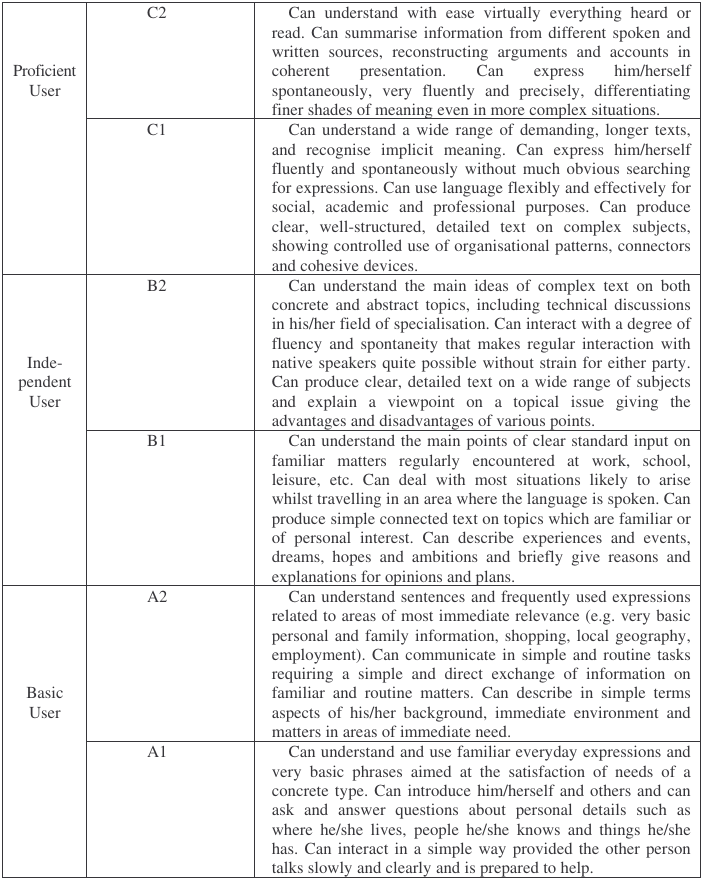
The majority of the examinations designed in Hungary are traditionally offered at three levels of language proficiency: Basic, Intermediate and Advanced. However, all the examination centers are required to align the levels of their examinations in the near future with The Council of Europe’s Common European Framework of Reference for Languages. (Basic level exams corresponding to B1, Intermediate to B2 and Advanced to C1 level). The Common European Framework (CEFR) describes what language learners have to learn to do in order to use a language for communication and what knowledge and skills they have to develop so as to be able to act effectively. The Framework also defines levels of proficiency, which allow the learners’ language knowledge to be measured. It offers six reference levels for several categories of language use, skills and sub-skills with detailed descriptions of the language ability required at the given level.: Basic User – A1 and A2, Independent User - B1 and B2, Proficient User - C1 and C2.
The table below gives a holistic, global summary of the set of proposed CEF levels